
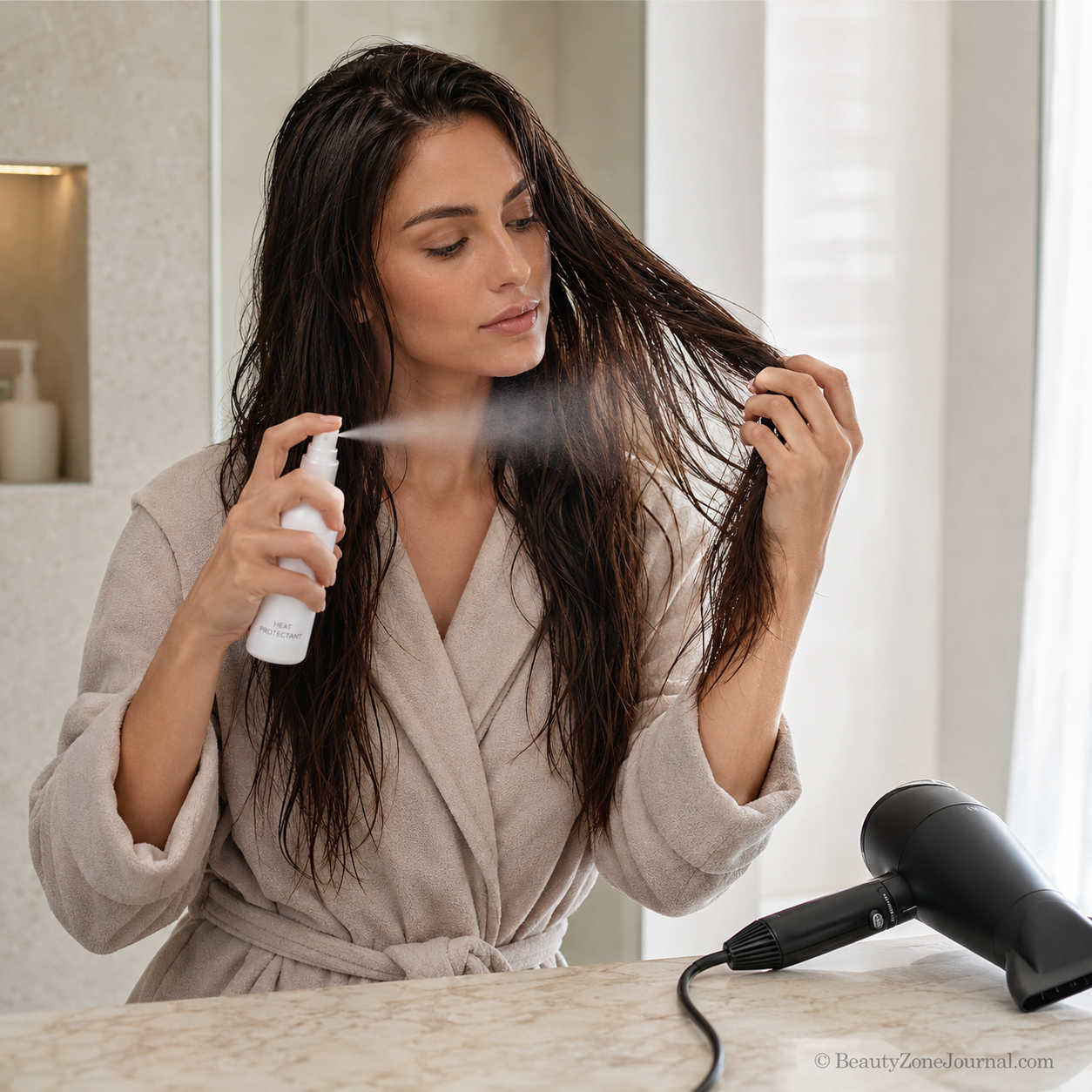
Hair dryers, hot air brushes, curling irons, and hair straighteners have become a regular part of styling hair at home.
The problem does not begin when we use them occasionally. It begins when the hair is regularly exposed to more heat than it can tolerate without visible changes.
First, the hair loses its smoothness. Then the ends become rougher, while the length tangles more easily, becomes frizzy, and starts to break during brushing.
That is why a heat protectant for hair should not be chosen simply because the packaging displays an impressive 230°C claim or because the formula contains plenty of oils.
A good product should suit your hair type, the styling tool you use, the temperature, and how often you heat-style your hair.
Below are 7 signs that can help you understand whether a heat protectant is genuinely suitable for your hair.
Table of Contents
Your Heat Protectant Should Match the Way You Style Your Hair

Not every product labeled heat protection works equally well with a hair dryer, hair straightener, or curling iron.
If you mostly blow-dry your hair, look for a product that spreads easily, helps the brush glide through the hair, and does not feel sticky.
When using a hair straightener or curling iron, it is especially important to check that the manufacturer specifically recommends the product for use with hot styling tools.
The logic is simple: the more directly a hot surface comes into contact with the hair, the more carefully you should consider the formula and application instructions.
| Styling tool | What to choose |
|---|---|
| Hair dryer | A spray, hair milk, or lightweight cream. It should spread easily and make the hair easier to brush. |
| Hot air brush | A spray or smoothing hair milk that does not leave the strands sticky. |
| Hair straightener | A spray or lightweight cream designed for heat styling. The hair should be completely dry before using the tool. |
| Curling iron | A lightweight heat protectant without a heavy, oily texture. It should not leave the hair damp. |
| Several hot styling tools | A multipurpose heat protectant labeled as suitable for different types of heat styling. |
Product Texture Matters More Than You Think
One of the most common mistakes is choosing a product with a good ingredient list that simply has the wrong texture for your hair.
Fine hair can lose volume even when the cream itself is high quality.
Porous hair, on the other hand, may not get enough conditioning from a very lightweight spray. It can remain rough, tangle more easily, and still look frizzy after blow-drying.
You can use this simple guide as a starting point:
| Hair type or condition | Product type to try first |
|---|---|
| Fine, soft, or quick to become oily | A spray or very lightweight fluid |
| Normal | A spray, hair milk, or lightweight cream |
| Dry | A hair milk or cream |
| Porous and frizz-prone | A cream, hair milk, or smoothing serum |
| Bleached or lightened | A lightweight cream or hair milk with conditioning ingredients |
| Thick and coarse | A cream or richer serum |
| Curly | A cream or hair milk, as long as it does not weigh down the curls |
However, there is no rule saying that thick hair always needs a heavy product or that fine hair can only tolerate a water-based spray. What ultimately matters is how your hair responds after several uses.
A Good Heat Protectant Does Not Need a Long “Perfect” Ingredient List

Ingredients that form a thin layer on the surface of the hair play an important role in heat-protection formulas. They can help reduce friction and allow the strands to glide more easily against one another.
The ingredient list may include:
- Silicones
- Polyquaterniums
- Film-forming polymers
- Conditioning agents
- Hydrolyzed proteins
- Panthenol
- Emollients
- Oils
Seeing familiar ingredient names in the INCI list does not guarantee that the product will provide effective heat protection.
INCI
INCI (International Nomenclature of Cosmetic Ingredients) is the international system used for naming cosmetic ingredients. Put simply, it is the ingredient list you see on product packaging.
For example, an oil can make the hair feel softer and look shinier, but the presence of oil does not automatically mean that a product works as a complete heat protectant.
That is why you should consider not only the ingredient list but also the product’s intended use and the manufacturer’s instructions.
A 180°C, 200°C, or 230°C Claim Is Not a Recommendation to Use That Temperature
The number displayed on the packaging is often misunderstood.
If a product claims to provide heat protection during styling up to a certain temperature, that does not mean you should set your styling tool to that temperature.
In everyday styling, the logic is different: using the lowest effective heat setting is generally the better choice.
This is especially important for:
- bleached hair;
- frequently color-treated hair;
- fine hair;
- dry hair;
- brittle hair;
- chemically treated hair.
If a section of hair straightens well at a lower setting, there is no reason to automatically turn the tool up to its maximum temperature.
A Heat Protectant Should Also Help Reduce Mechanical Damage
Hair can be damaged by more than heat during styling.
We pull it taut with a round brush, run a brush through wet strands, clamp it between the plates of a hair straightener, and repeatedly pass the tool over the same section.
For already damaged hair, this type of mechanical stress matters too.
That is why a good heat protectant often provides several additional benefits:
- makes the hair easier to comb;
- reduces snagging between strands;
- leaves the surface of the hair feeling smoother;
- helps the brush glide more easily;
- reduces frizz;
- does not leave a stiff film on the hair.
If the hair becomes sticky and more difficult to comb after application, the product may simply be unsuitable for your particular hair texture.
Bleached and Porous Hair Needs a Different Approach

Heat-styling mistakes often become visible most quickly on bleached hair.
The hair may look smooth immediately after straightening but become frizzy and dry again only a few hours later.
This does not necessarily mean that the heat protectant is not working. In many cases, heat straightening only temporarily changes the appearance of the hair’s surface, while the hair itself remains damaged.
For this type of hair, I would look beyond the words heat protection and also consider whether the product:
- provides enough slip;
- does not leave the lengths feeling drier;
- does not cause the ends to stick together;
- leaves the hair feeling softer once dry;
- allows you to style the hair without repeatedly passing the straightener over the same section.
Another important point is that a heat protectant cannot restore hair that has already been structurally damaged.
It helps reduce further damage during heat styling.
If your hair is already heavily damaged, it may also help to understand what a hair reconstruction treatment can and cannot realistically do.
The Best Heat Protectant Is One You Can Apply Evenly

Even a very good formula will offer limited help if the product reaches only the top layer of the hair.
If your hair is thick or long, divide it into several sections before applying the product. This helps distribute it much more evenly.
Before blow-drying, heat protectant is usually applied to damp, towel-dried hair.
You can then gently comb the product through the lengths.
Before using a hair straightener or curling iron, the hair should be completely dry unless the manufacturer of the specific product provides different instructions.
Another small detail can make a significant difference to the result: using more product does not mean getting more protection.
Too much cream or serum can leave the strands heavy and sticky and may make the hair take longer to dry.
How to Tell If a Heat Protectant Is Not Right for You
You do not always need to wait until you have finished the entire bottle.
The product is probably not right for you if, after several uses, your hair:
- becomes noticeably oily more quickly;
- looks stuck together;
- feels stiff to the touch;
- takes longer to dry;
- loses volume;
- becomes difficult to comb;
- looks weighed down after straightening;
- requires a higher temperature for the finished style to look smooth and polished.
The final point is especially revealing. If a product leaves a heavy layer on the hair and this makes you turn up the temperature of your straightener, some of the purpose of using that “protection” is lost.
Should You Look for a Silicone-Free Heat Protectant?
Not necessarily.
Silicones are often used in hair products because they can help smooth the surface of the hair, improve slip, and reduce friction.
The problem may not be the ingredient itself. The specific formula may simply be too heavy for your hair or may not wash out easily with your usual shampoo.
For fine hair, it therefore makes more sense to look beyond a “silicone-free” label and choose a lightweight heat protectant that does not reduce volume.
Spray, Cream, or Hair Milk: Which Should You Choose?
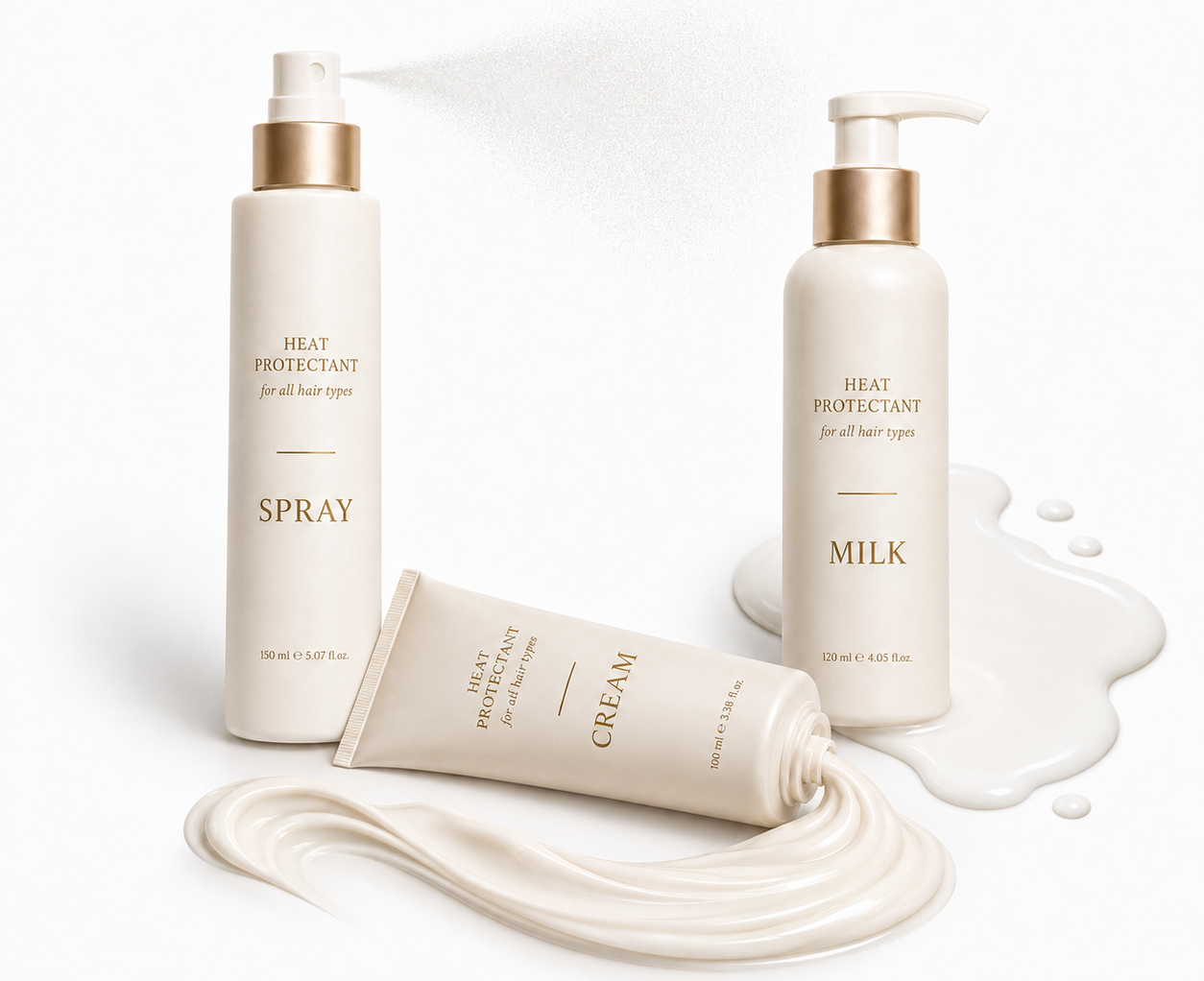
If you are not sure where to begin, you can use this simple guide:
Spray: when you want a lightweight product.
Hair milk: when you want a balance between lightness and softness.
Cream: when your hair is dry, porous, or needs more smoothing.
Serum: when smoothness and frizz control are important, but the amount needs to be carefully controlled.
Do not rely too heavily on the product name printed on the packaging. Two products labeled as a “cream” can behave very differently on the hair.
5 Mistakes That Make Even a Good Heat Protectant Less Effective
- Applying it only to the top layer of the hair. The strands underneath are left with little or no product.
- Using a hair straightener on damp hair. Unless the specific tool is designed for this purpose, it is better to avoid doing so.
- Choosing the maximum temperature “to save time.” Faster does not always mean gentler.
- Passing the tool over the same section several times. In some cases, one slow, controlled pass at a moderate temperature is better than multiple repeated passes.
- Trying to compensate for damage by applying more oil. Oil may improve the appearance of the ends, but it cannot restore a damaged hair fiber to its original structure.
How to Choose a Heat Protectant in 30 Seconds
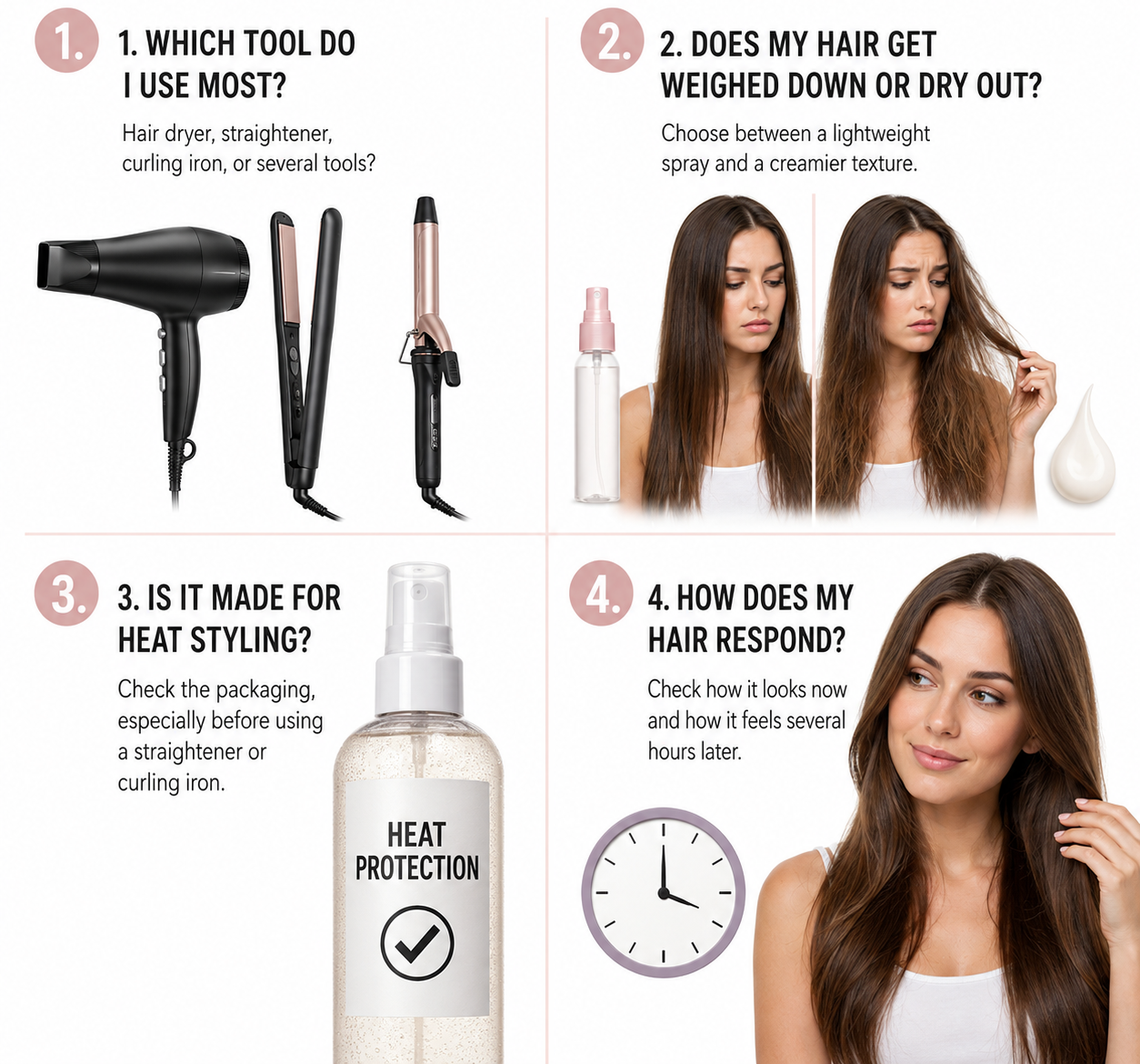
Before buying a product, ask yourself four questions:
1. Which tool do I use most often to style my hair?
A hair dryer, hair straightener, curling iron, or several different tools?
2. Does my hair tend to become weighed down or dry out?
This will help you choose between a spray and a creamier texture.
3. Does the packaging clearly state that the product is intended for heat styling?
This is especially important if you plan to use a hair straightener or curling iron.
4. How does my hair respond to the product?
Consider not only how it looks immediately after styling but also how it feels several hours later.
These four questions can often tell you more than a long list of trendy ingredients on the packaging.
The Bottom Line
A good heat protectant for hair is more than a product with an impressive temperature claim on the packaging.
It should suit the way you style your hair, spread easily, avoid weighing down the strands, and help reduce friction during blow-drying or straightening.
Most importantly, do not try to compensate for excessive heat with cosmetic products.
Even a high-quality heat protectant works best when the hair is not overheated, the tool is not held in one place for too long, and the same section is not repeatedly exposed to heat.
The combination of the right product + a moderate temperature + careful styling technique makes the greatest difference in helping preserve the hair’s smoothness, flexibility, and overall appearance.
Common Questions About Heat Protectant for Hair
Do I need to change my heat protectant between summer and winter?
Not necessarily. However, the condition of your hair can change throughout the year. In winter, the lengths may need more softness, while a heavy cream may feel unnecessary in summer.
In summer, heat styling is not the only source of stress on the hair. If you spend a lot of time in strong sun, you may also want to know whether SPF for hair can help protect against sun damage. Focus less on the season itself and more on how your hair is behaving at the moment.
Can a heat protectant prevent curls from holding?
It can happen if the formula is too heavy or if too much product has been applied. When using a curling iron, a lightweight product that does not leave the hair overly slippery or weighed down is often a better choice.
Should I reapply heat protectant if I blow-dried my hair in the morning and want to use a straightener in the evening?
Follow the instructions for the specific product. Some formulas are intended for a single styling session, while others can be reapplied. If you apply the product again, avoid overloading the hair and make sure it is completely dry before using a straightener.
Why does my hair sometimes appear to smoke when I use a straightener?
Visible steam or vapor may appear if there is still moisture in the hair or if too much product has been applied. Before using a straightener, make sure your hair is completely dry and follow the instructions provided with both the styling tool and the product.
Can I use a heat protectant with a leave-in conditioner?
Yes, as long as the products work well together and do not weigh down the hair. In some cases, one multipurpose leave-in product may be enough if the manufacturer specifically states that it also provides heat protection.
Is a more expensive heat protectant always better?
No. The formula, suitability for your hair type, even application, and correct use of hot styling tools matter more than the price. An expensive cream that weighs down fine hair will be a less suitable choice than a simple, lightweight spray.