

You want to get a tattoo together, but matching hearts, initials, or names feel a little too obvious.
A shared design can be much more personal than that. Two tattoos do not have to be exact copies – sometimes the connection is hidden in a small detail, a shared theme, or a design that continues from one person to the other.
Matching tattoos are not just for couples.
Friends, siblings, mothers and daughters, fathers and sons, and other close family members choose them too. And there is plenty of room to make them individual: each person can keep their own style, size, and placement.
Below, we’ll look at different ways to build a matching design, ideas for different relationships, and a few details worth discussing before you book your appointment.
Table of Contents:
Matching tattoos do not have to be identical
The most obvious option is to repeat the same design on two people. This works especially well for small, simple tattoos without too many fine details.
But an exact copy is only one option.
Sometimes it is more interesting to start with one shared theme and interpret it in two different ways.
If you both love the sea, for example, one tattoo might feature a wave while the other shows a shoreline or lighthouse. The designs are different, but the connection is still clear.

Another option is to split one idea into two separate pieces. Each tattoo works on its own, but placing them side by side reveals another detail or completes the scene.
| Option | Best for | What to consider |
|---|---|---|
| Identical designs | people who want an obvious visual connection | the same size may not suit different body areas equally well |
| Complementary tattoos | couples, friends, and family members | each design should still feel complete on its own |
| One theme, two interpretations | people with different tastes | decide which detail will connect the two designs |
| A hidden shared element | people who want a subtle connection | the link between the tattoos may be almost invisible to others |
Before making a final decision, look at each design separately. If you would still like your tattoo without the second one beside it, that is usually a good sign.
Matching tattoos for couples
A couple tattoo does not have to literally say “love.” Instead of hearts, dates, or names, you can start with something that genuinely connects the two of you.
It might be a place, a shared trip, music, nature, a favorite theme, characters, or a small detail that only the two of you understand.

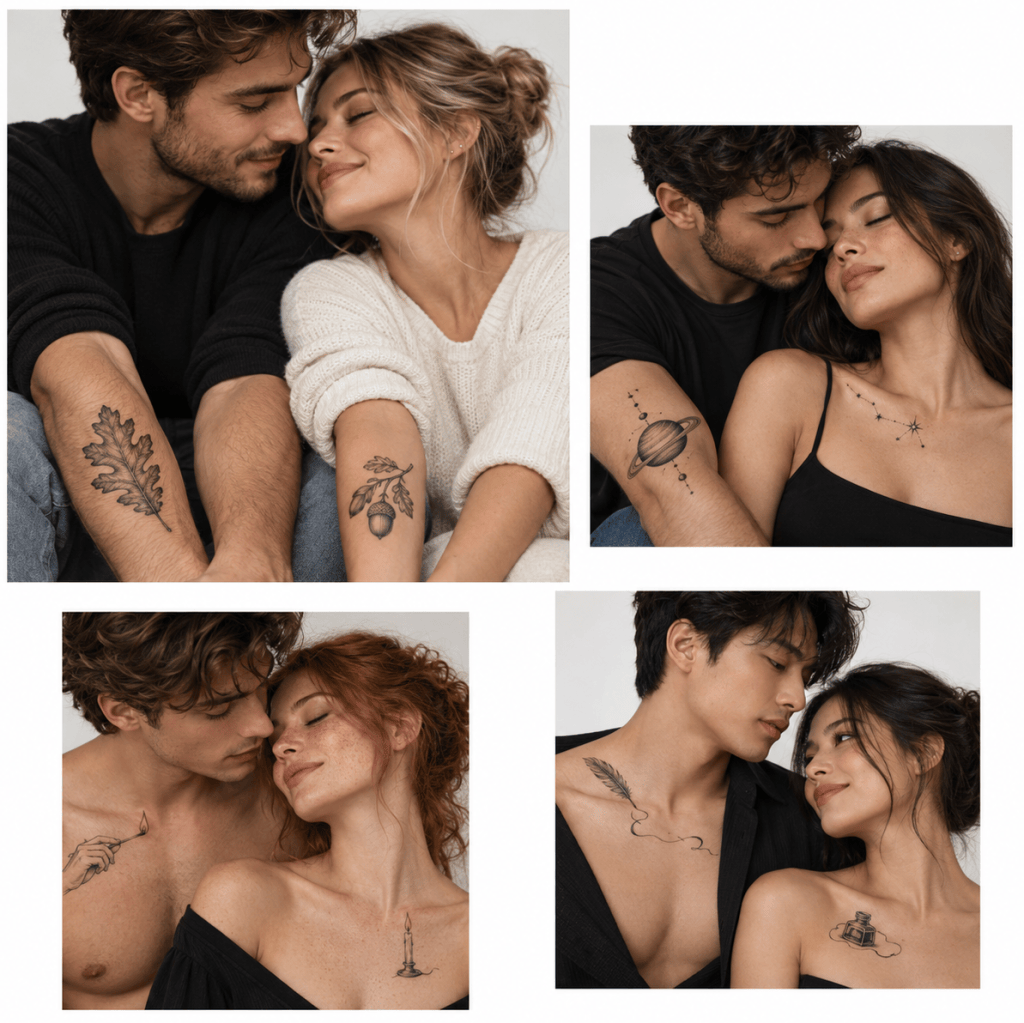
Two designs that connect
This idea works especially well when the tattoos can be placed next to each other.
For example:
- two parts of one landscape;
- a line that begins on one tattoo and continues on the other;
- two characters from the same story;
- different parts of a celestial design;
- two plants from the same botanical theme;
- two objects that naturally belong together.
The connection does not need to line up perfectly. If the design only works when two arms are held at one very specific angle, you may rarely see the full effect in everyday life.
It is usually better when each tattoo has a complete composition of its own, with an extra layer of meaning appearing when the two are together.
One shared theme instead of two copies
Partners can have completely different tastes. One person may prefer fine, delicate lines while the other likes something bolder and more detailed.
There is no reason to settle on a compromise that neither of you truly loves.
Instead, choose one theme – the ocean, space, mountains, plants, or a meaningful object – and create two different designs around it. A small detail, shape, or repeated element can be enough to tie them together.
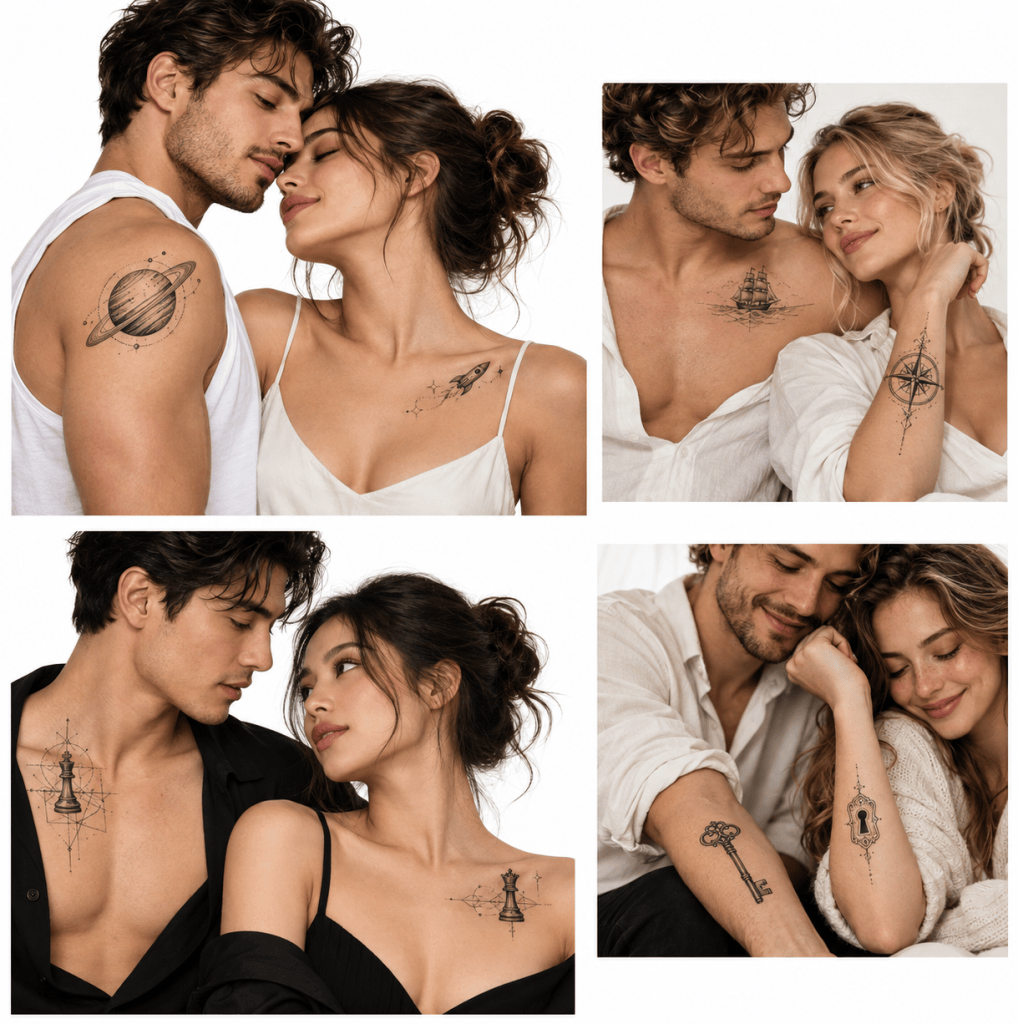
This works especially well when the tattoos will be different sizes or placed on different parts of the body.
A personal detail instead of a name
A partner’s name is not the only way to make a tattoo feel personal.
The outline of a meaningful place, a familiar object, part of a landscape, or a small detail from a shared memory can feel much more individual.

To everyone else, it may simply look like a beautiful tattoo. To you, it carries another layer of meaning.
That meaning does not have to be obvious in the design. Some parts of the story can stay private.
Matching tattoos for friends
Friendship tattoos leave plenty of room for creativity. They can be sentimental, funny, built around a shared interest, or inspired by travel, music, sports, films, or an inside joke that has lasted for years.
They do not need to match exactly either.
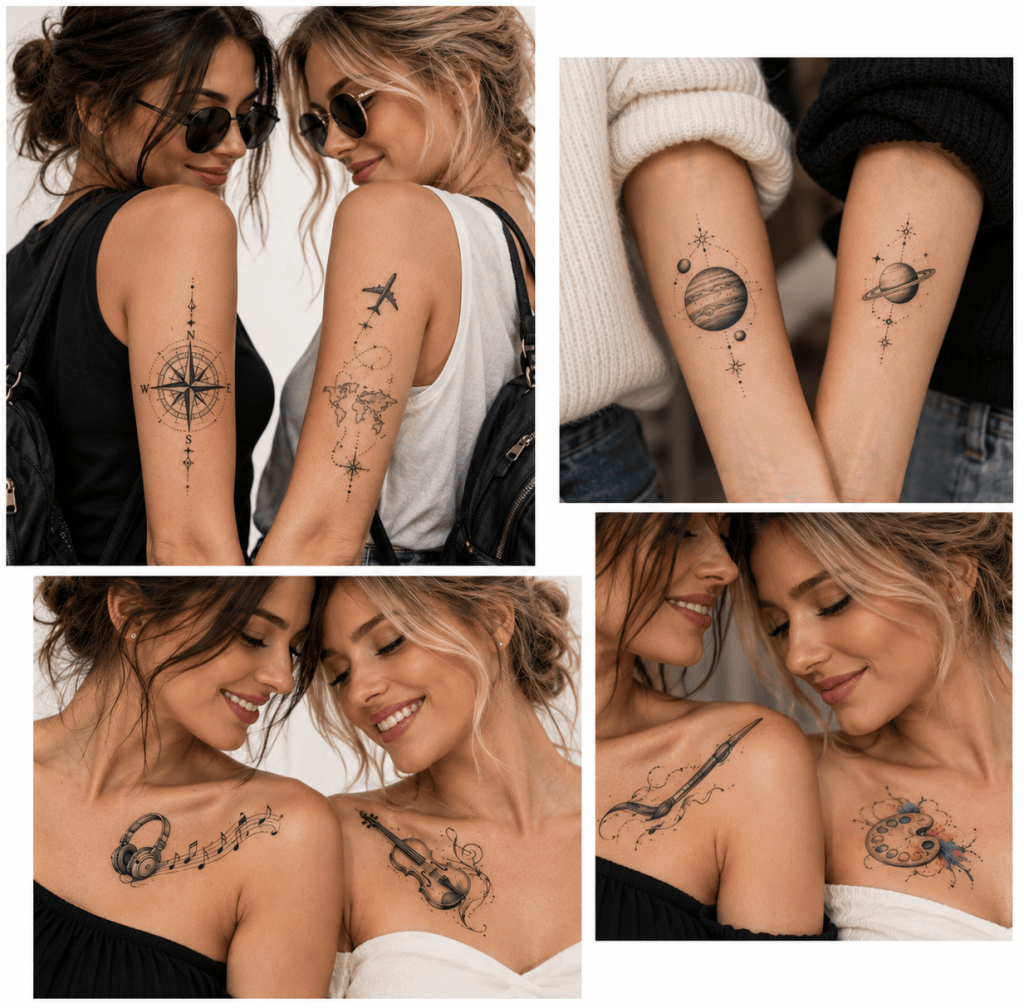
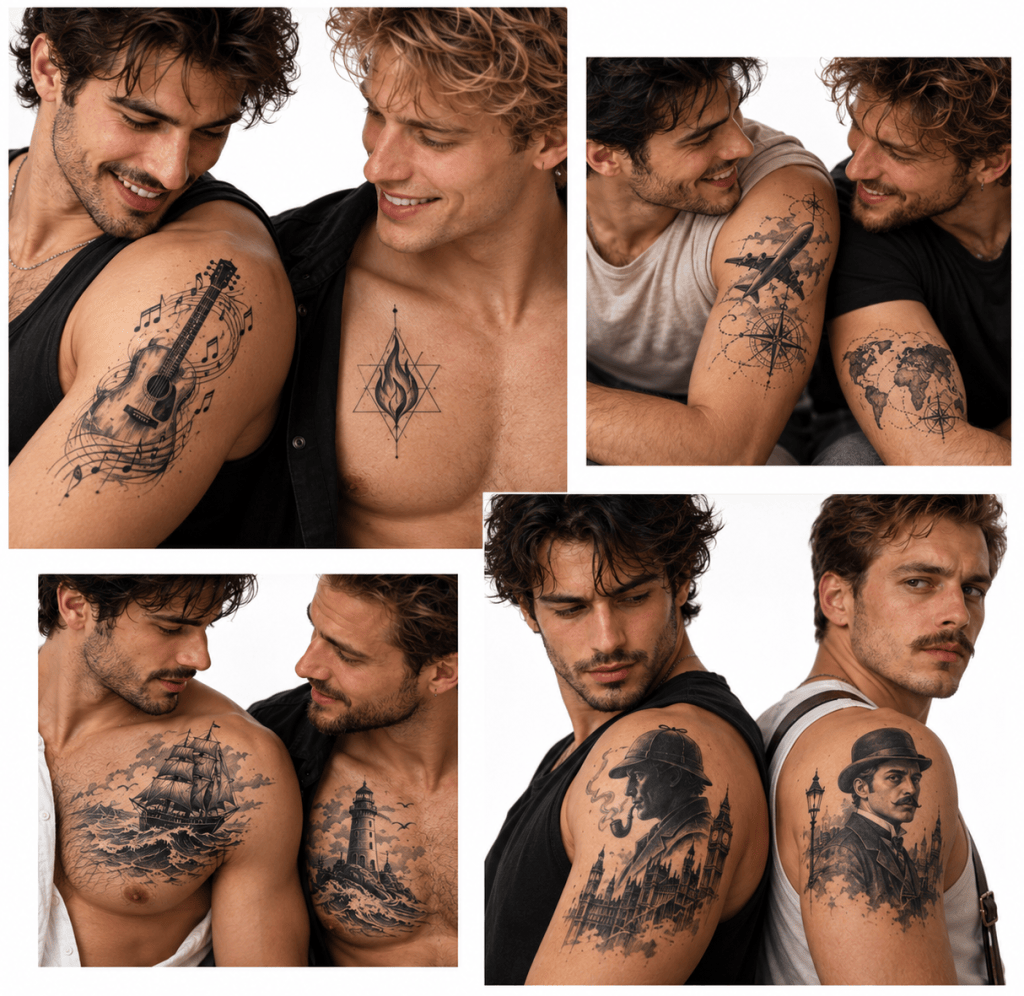
Ideas could include:
- coordinates of an important place;
- mountains or different parts of the same landscape;
- a compass and a route;
- a wave and a shoreline;
- a planet and a constellation;
- different characters from the same story;
- two objects that belong together;
- the same geometric shape with different details inside;
- one shared motif interpreted in different ways.
If one friend likes minimal tattoos and the other prefers more detailed work, there is no need to meet somewhere in the middle. One repeated element can be enough.
It might be a tiny star inside two very different space-inspired designs, or the same horizon line running through two completely different landscapes.
A shared idea does not require the same style.
This also works well for groups of three or four friends. Instead of repeating one tattoo several times, each person can take a different element from the same theme.
Matching tattoos for mothers and daughters
With mother-and-daughter tattoos, the goal is often to show closeness without making the idea feel too literal.
One option is to start with the same theme and adapt it for each person.
You might choose two parts of the same nature-inspired scene, two plants from one composition, or a small detail repeated in both designs.
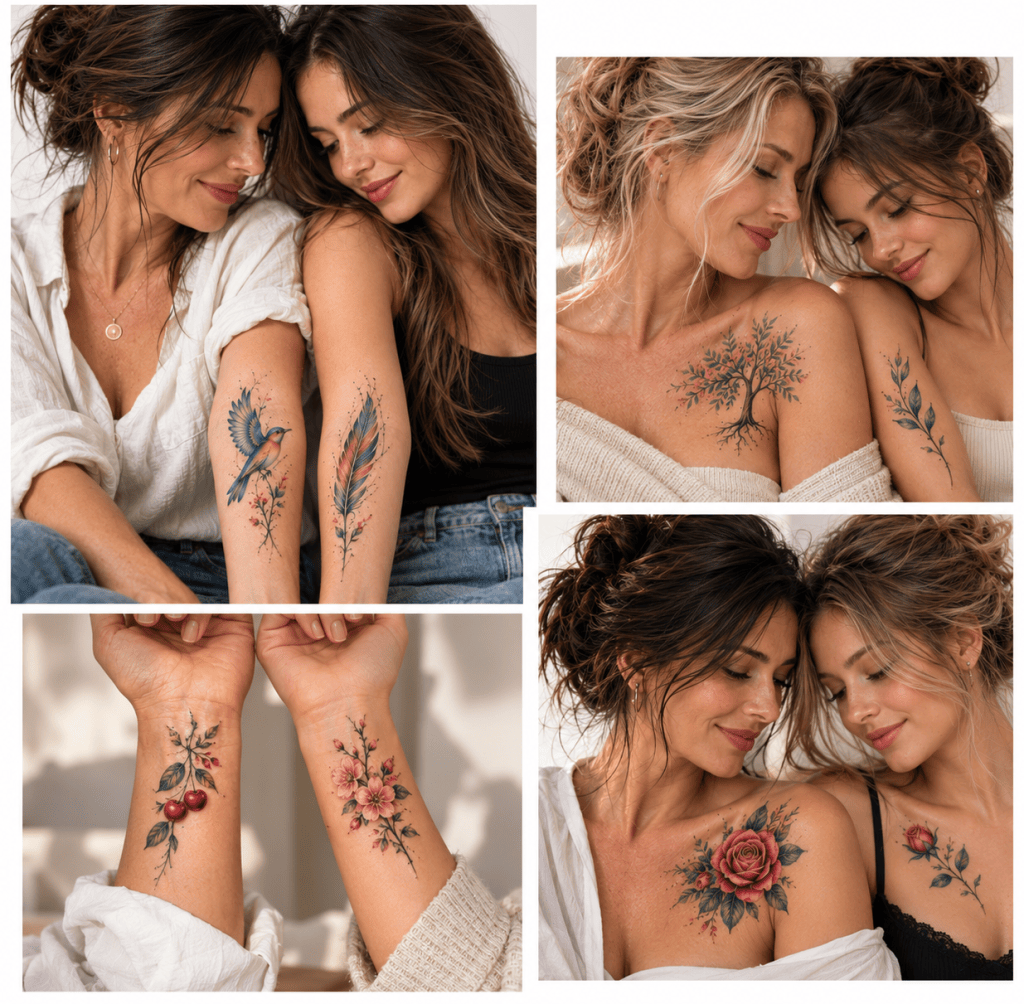
A mother may prefer something smaller and more understated, while her daughter may want a more noticeable version. The tattoos can still feel connected.
They do not need to be placed in the same spot either. A design may sit beautifully on one person’s forearm but work better on the other person’s shoulder or another area.
If this is a first tattoo for either of you, it helps to know what the skin may be like after the appointment.
My guide to tattoo aftercare for women explains what typically happens during the first two weeks and what to expect while the skin heals.
Matching tattoos for fathers and sons
A father-and-son tattoo does not need to spell out the family relationship.
A place, activity, object, or memory that matters to both of you can be a more natural starting point.
That might mean coordinates of your hometown, a mountain landscape, the sea, a mechanical detail, two connected objects, or one minimal symbol interpreted in two different ways.
You can also split a single idea between two designs.
One tattoo might show part of a route while the other continues it. Or you can choose the same motif and adapt it to suit each person’s individual style.
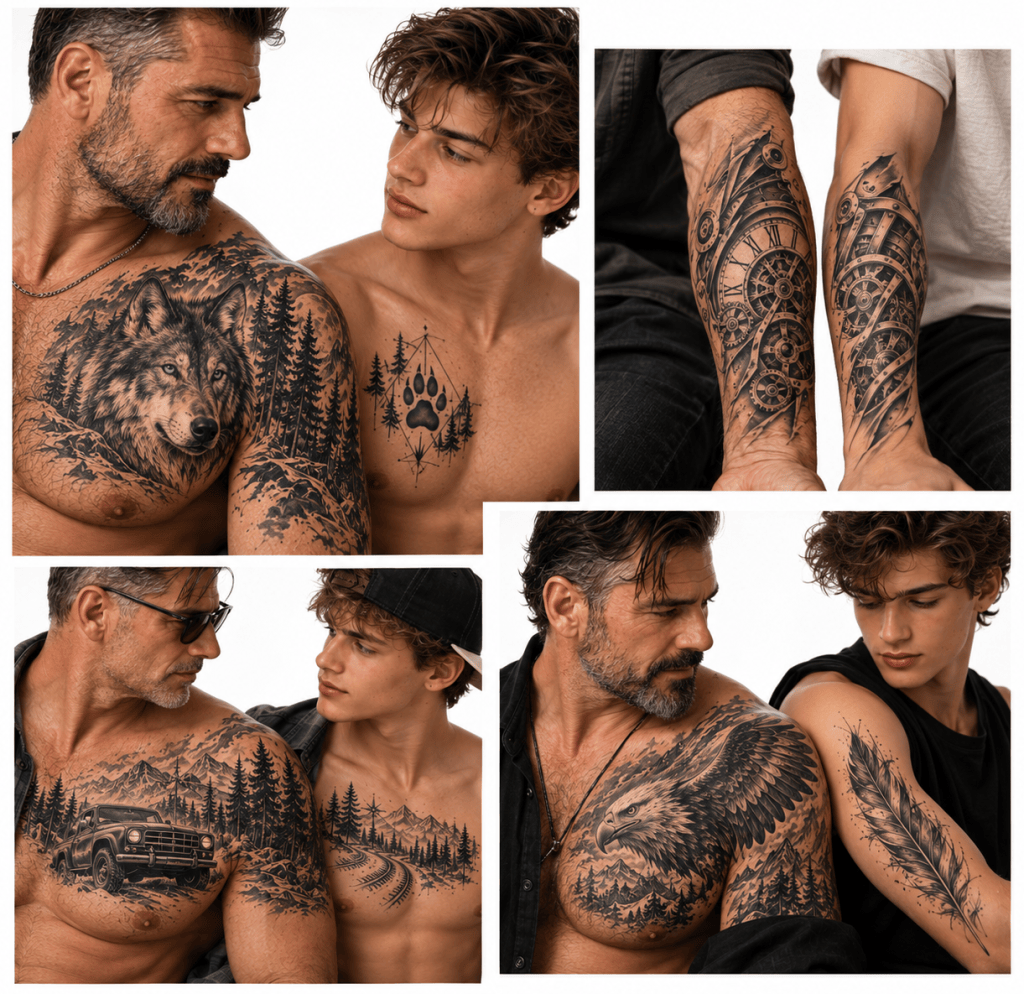
If you want the design to carry a particular meaning rather than simply look good, you can explore the meaning behind different men’s tattoo symbols separately.
After the appointment, each tattoo heals independently, even if both were done on the same day. Film, exercise, and practical healing details are covered separately in my guide to tattoo aftercare for men.
Matching tattoos for siblings
Brothers and sisters can build a shared design around childhood memories, family history, or simply a theme they both like.
“One story, two designs” works particularly well here.
You might choose different elements from the same landscape, two characters, objects from the same theme, or one small matching detail placed inside two otherwise very different tattoos.
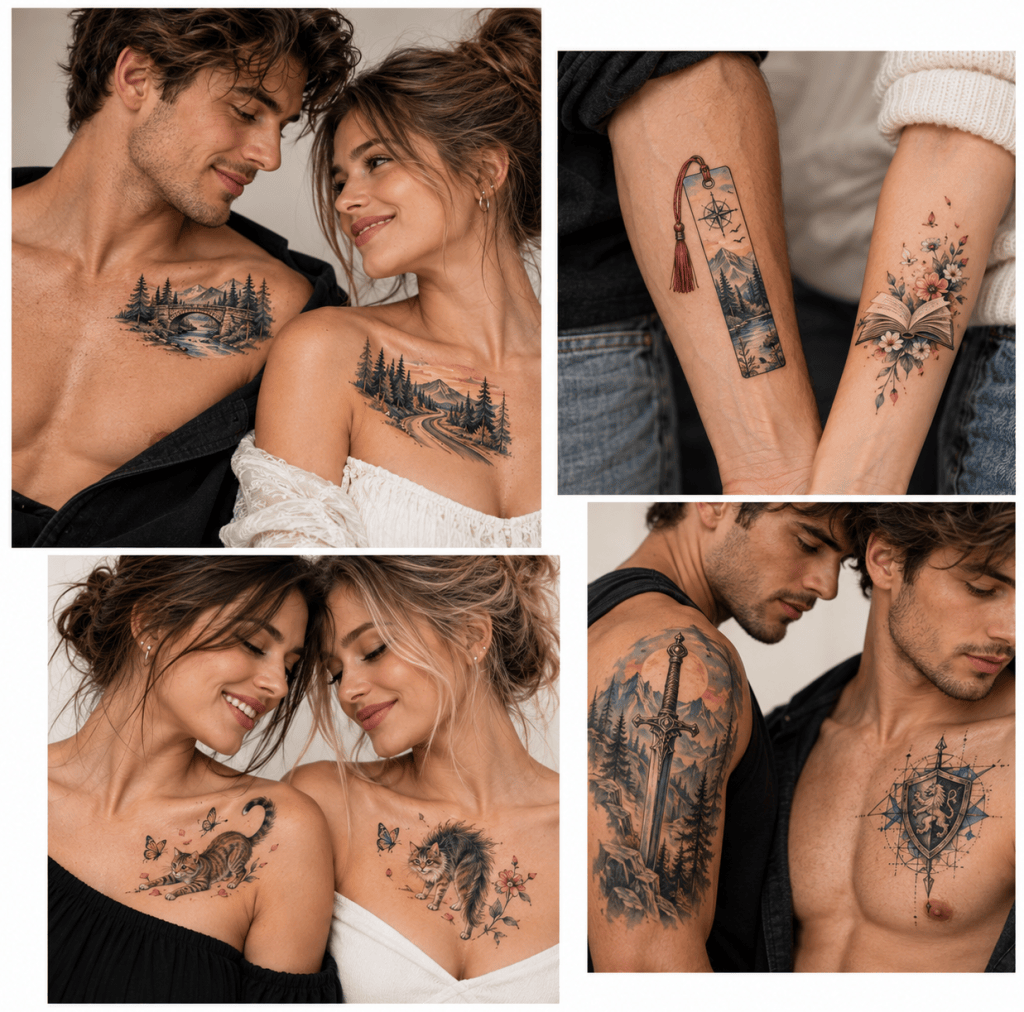
This can be especially useful for a brother and sister with very different tastes.
There is no need to decide whether the tattoo should feel more “masculine” or “feminine.” Each person can have a design that suits them, while the connection stays in the idea behind it.
The same approach works for two sisters or two brothers. Matching does not have to mean identical.
Matching tattoos for parents and adult children
Not every family tattoo fits neatly into a mother-and-daughter or father-and-son category.
A mother and son, father and daughter, or several adult family members can all share one concept. In those cases, a theme that can be adapted for several people often works best.
Each person might have one part of the same landscape, for example, or the same small detail placed inside an individual design.

For a family of three or four, this can feel more personal than repeating the exact same tattoo several times.
Another option is to use an object or place with shared family meaning. It does not need to be drawn literally. A tattoo artist can take a recognizable shape, outline, or detail and turn it into an individual design.
How to create a matching tattoo that each person genuinely likes
The search often starts with photos of finished tattoos. Before that, though, it helps to decide what is actually supposed to connect your designs.
It might be:
- one shared story;
- a specific place;
- a hobby or interest;
- one shape;
- a repeated detail;
- two parts of the same scene.
Once you have that, each person can describe what they want their own tattoo to feel like.
This helps avoid a situation where one person genuinely wants the tattoo and the other agrees mainly because “we said we would do it together.”
There is a simple test: imagine the second tattoo does not exist. Would you still want to wear your own design?
If the answer is yes, the shared idea already has a solid foundation.
What to discuss with your tattoo artist before the appointment
Even two identical designs are still two separate tattoos on different bodies and different areas of skin.
Before the session, agree on:
- which parts should stay the same;
- whether the scale can change;
- where each tattoo will be placed;
- whether the two designs should connect;
- how much fine detail can realistically stay in the design;
- whether each tattoo works visually on its own;
- how the design should be adapted if the placements are different.
If your artist suggests adjusting the size or spacing between details, it does not mean the matching idea will be lost. Sometimes those small changes simply help each tattoo sit better on the body.
Safety matters more than perfect symmetry
Even the smallest matching tattoo breaks the skin, so choosing a reputable studio and artist matters just as much as choosing the design. The FDA’s tattoo safety guidance is a useful reference if you want to read more about potential risks.
Do not accept questionable conditions just because you want the tattoos done on a particular date or at the same time.
The skin may also react differently from one person to another after the appointment. Redness, tenderness, and the pace of recovery depend on individual skin response, the amount of work done, the placement, and other factors – not on the fact that the tattoos are a matching pair.
If the area is not healing, you develop a rash, redness becomes unusually worse, or something else concerns you, do not judge your tattoo by how the other person’s skin looks. Pay attention to your own symptoms.
Common Questions
Do both matching tattoos need to be done on the same day?
No. Once the designs are finalized, they can be tattooed at different times without changing the idea behind them.
Do we need to use the same tattoo artist?
Not necessarily. But if you want the linework, technique, and overall finish to be as similar as possible, using the same artist can help create a more consistent look.
Can matching tattoos be different colors?
Yes. The same motif can be black and gray on one person and colored on the other, as long as the design works well both ways.
Can a third person be added to an existing matching tattoo idea?
Sometimes. It is easier when the original tattoos share a theme or repeated element rather than forming two exact halves. The new piece is best planned with an artist so it feels intentional rather than added on later.
Can two identical tattoos age differently over time?
Yes. Placement, skin condition, sun exposure, healing, and time can all affect how a tattoo changes. Even two identical tattoos will not necessarily age in exactly the same way.