
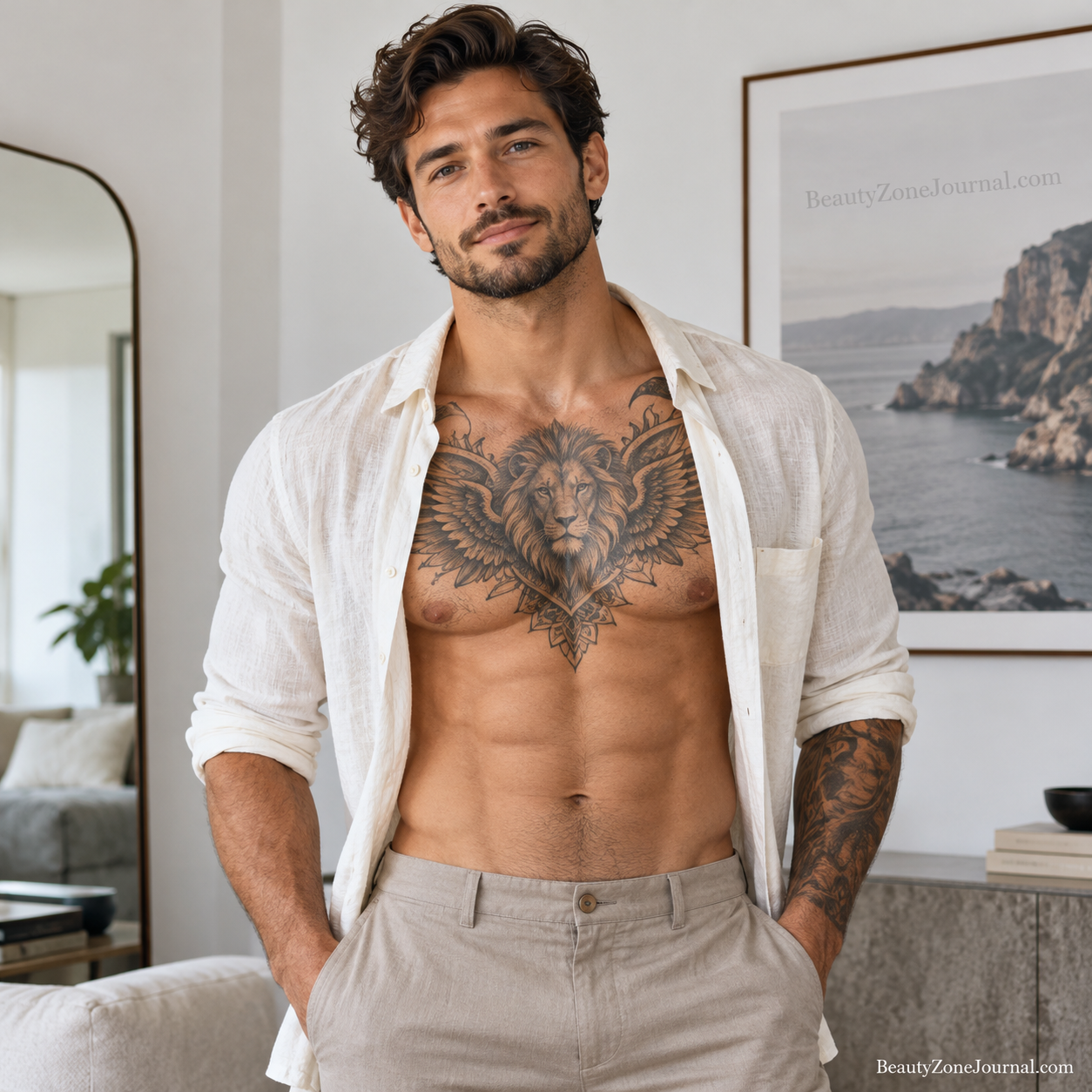
Chest tattoos for men work especially well when you want enough space for a larger design without having it on display all the time.
The chest gives an artist room to build a composition around the natural lines of the body, while still letting you decide when the tattoo is visible.
For many men, a chest tattoo is not an impulsive choice. It is often something they plan after already having other tattoos, or when they have a clear idea of what they want the piece to say or represent.
Below, we’ll look at the designs that work best on the chest, how placement changes the overall look, how painful the area can be, and what to think about before your appointment.
Table of Contents
Why the Chest Works So Well for Larger Tattoo Designs
The chest gives you a wide, relatively flat area to work with, which makes it easier to build a larger composition than on the arm or leg.
A design can follow the collarbone, curve around the nipple, extend toward the sternum, or stay on just one side of the chest. In fact, asymmetry can work especially well in this area.
There is one practical downside: a chest tattoo is easy to see when your shirt is off, but almost completely hidden when you are dressed.
If you want the tattoo to stay out of sight under a T-shirt, it is worth planning the upper edge of the design below the neckline from the start.
Which Chest Tattoo Designs Work Best for Men
Chest tattoos tend to look best when the design has a clear focal point or a strong direction.
The composition can follow the shape of the chest muscles, spread outward from the sternum, or stay only on the right or left side of the chest.
| Design | Placement and what to consider |
|---|---|
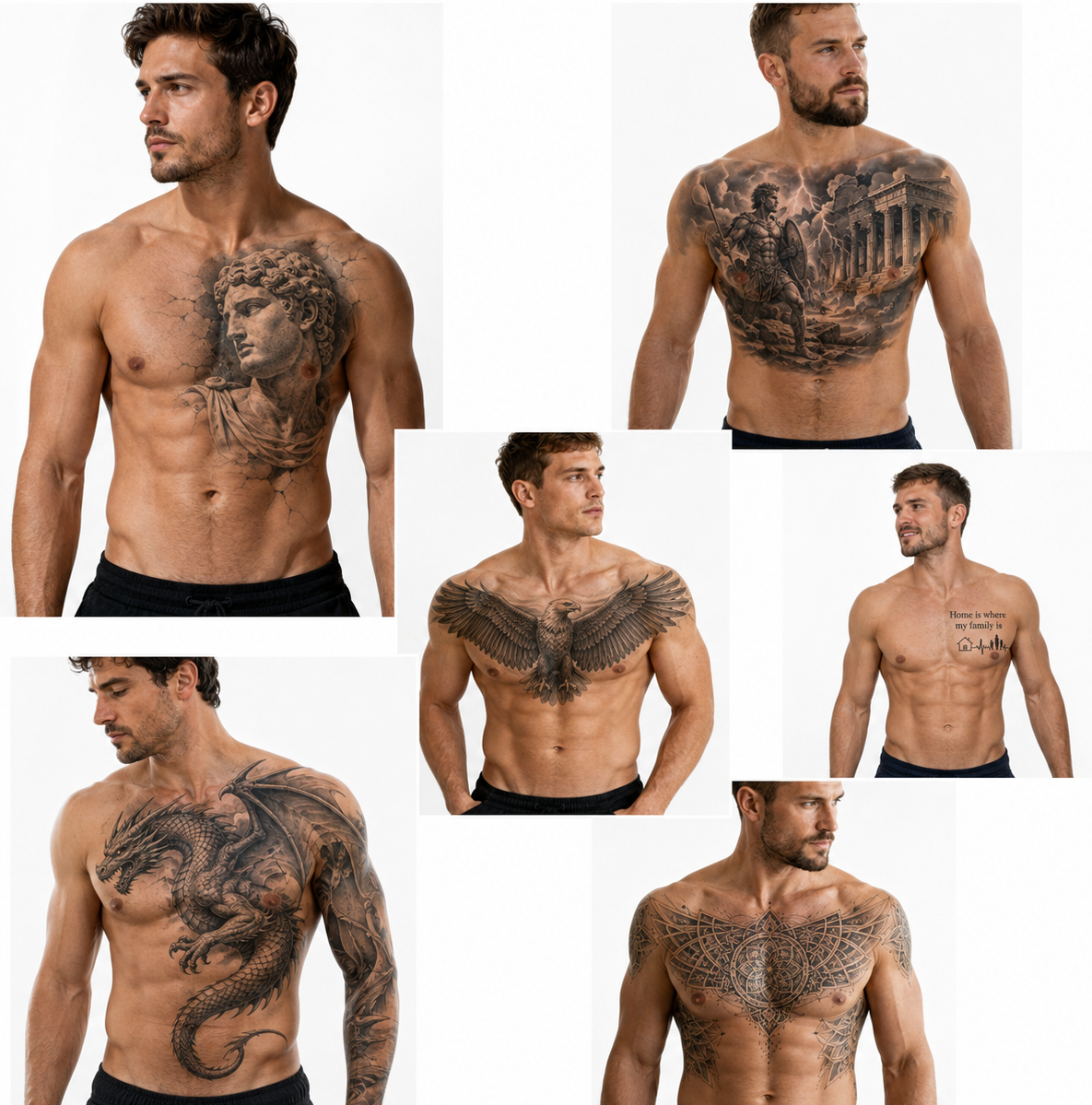
| Lion, tiger or bear | Works well in the center or on one pectoral. A detailed animal face needs enough space to stay clear. |
| Eagle | Often placed from shoulder to shoulder. The curve of the wings should follow the line of the collarbones. |
| Wolf | Works well on one side of the chest with a transition toward the shoulder. Forest or mountain elements can be added around it. |
| Dragon | Can run diagonally across the chest or continue onto the arm. The body of the dragon should follow the natural lines of the muscles. |
| Skull and clock | Usually works best on one side or closer to the center. Detailed designs should not be made too small. |
| Wings | Usually placed symmetrically from the sternum. Accurate placement on both sides is especially important. |
| Geometric design | Can be centered, follow the collarbones, or extend across the full width of the chest. |
| Lettering | Works well under the collarbone, over the heart, or along the curve of the pectoral muscle. |
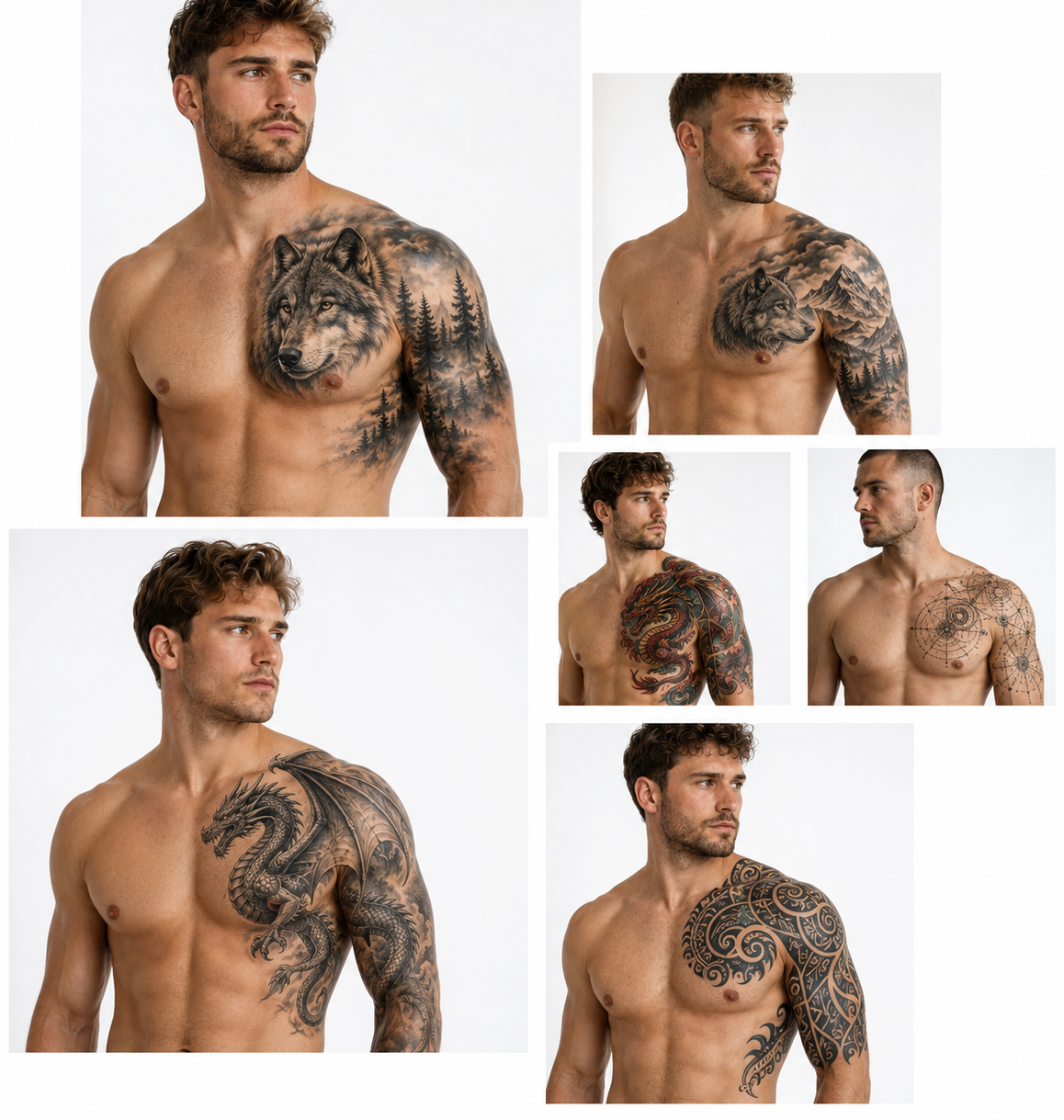
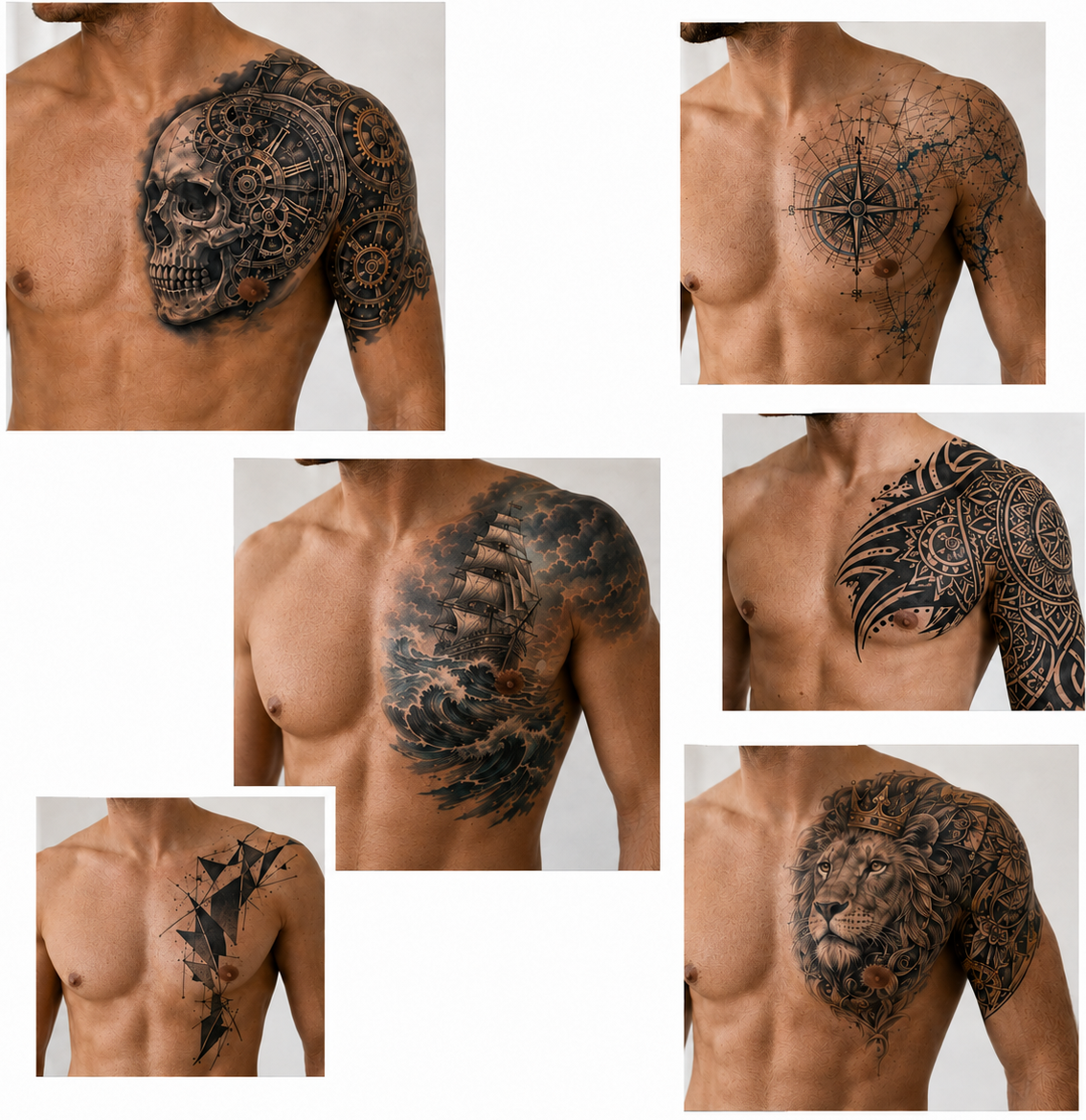
The examples below show how much the size and direction of a design can change the overall look of a chest tattoo.
Pay attention not only to the subject itself, but also to how the outline works with the collarbones, the shape of the chest muscles and the transition toward the shoulder.
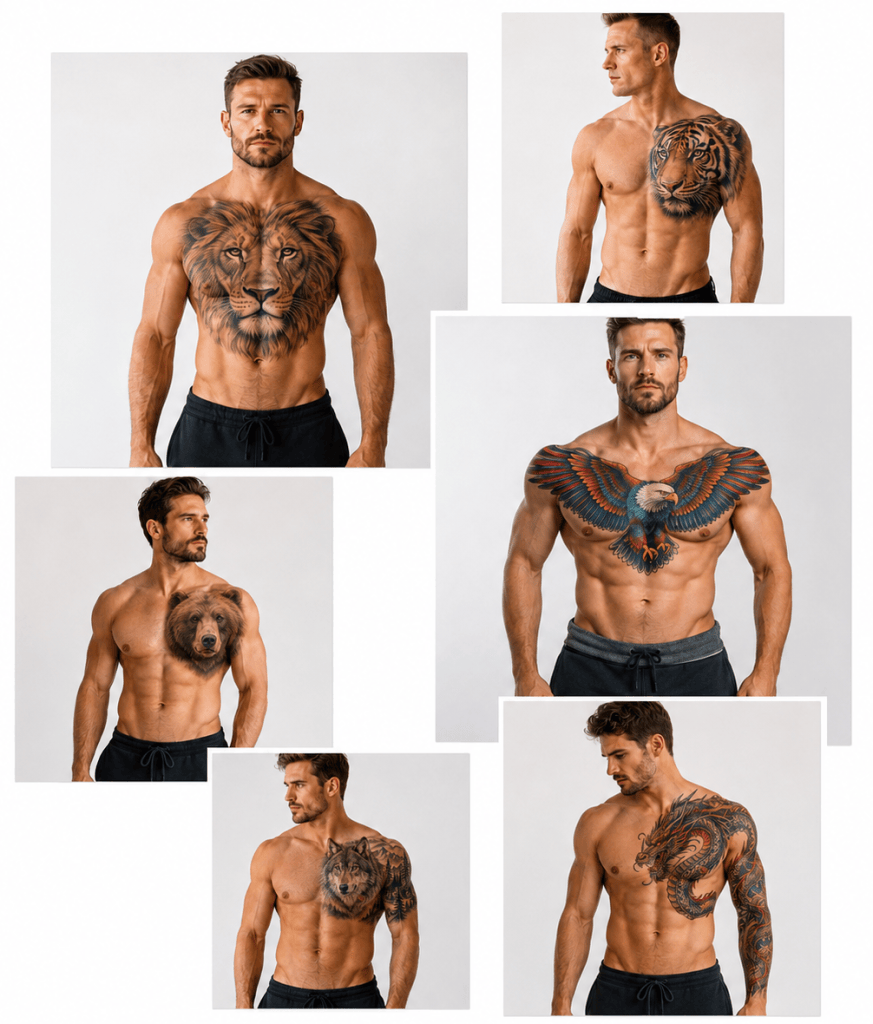

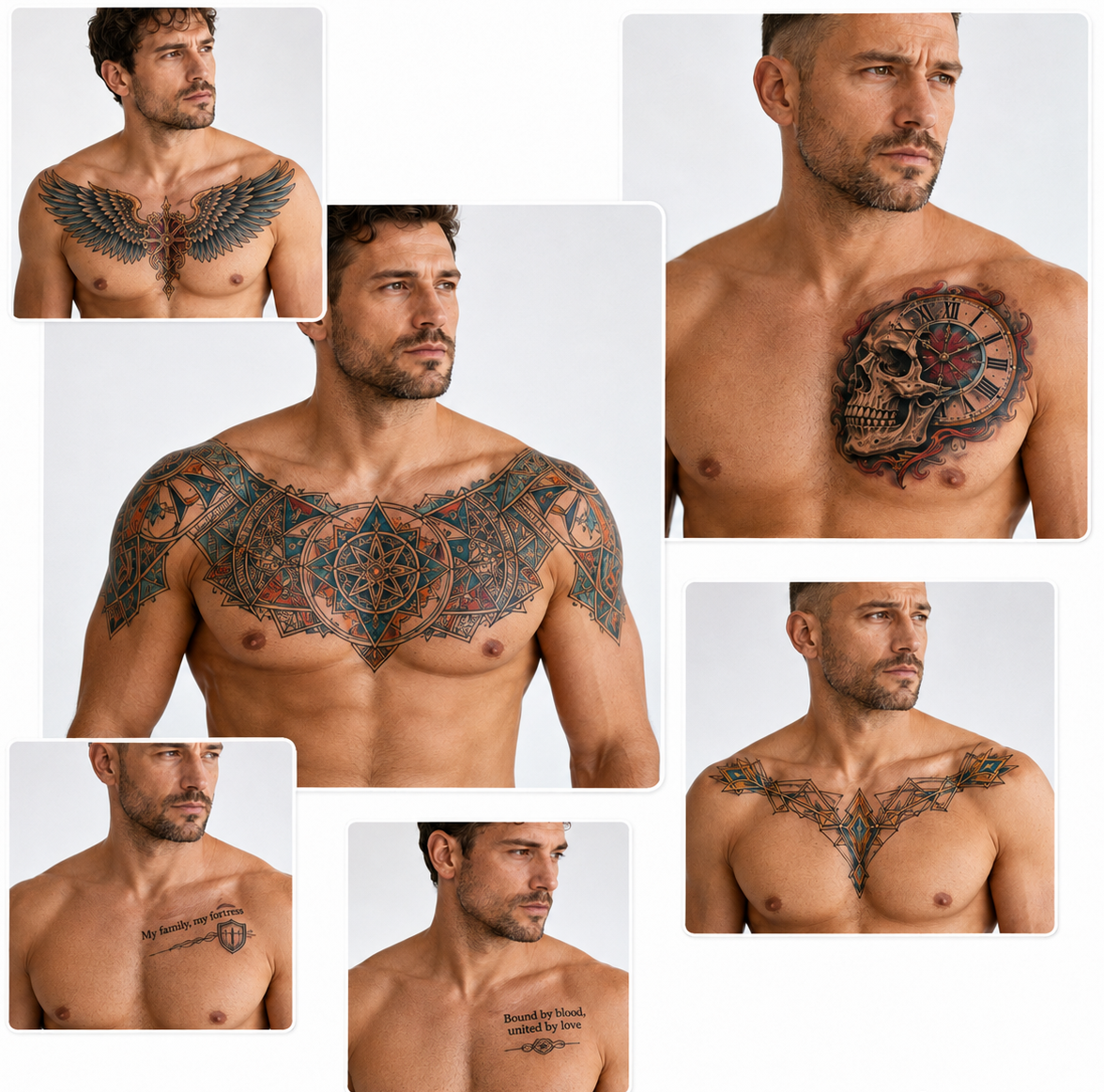
Use these examples as inspiration for the overall composition rather than as designs to copy exactly.
Even a familiar subject can look more interesting when the artist adapts it to the width of the chest, the shape of the muscles and the possibility of extending the tattoo onto the shoulder or arm later.
You also do not need to fill the entire chest.
A small piece of lettering, coordinates, a date or a minimal symbol over the heart can sometimes look stronger than an overloaded composition without a clear focal point.
Symmetrical or Asymmetrical Chest Tattoo
Symmetrical tattoos can emphasize the width of the shoulders and the natural shape of the torso.
Wings, ornamental designs, geometric patterns, paired animals, or a central image with details extending to both sides are common choices. These designs require very precise placement, so the artist should check the stencil not only while the client is lying down, but also while standing.


An asymmetrical chest tattoo gives you more freedom.
It can cover one pectoral muscle, extend onto the shoulder, or become the starting point for a future sleeve.
This type of design is easier to expand later, but the direction of the composition is still worth planning before the first session.
When choosing between the two, think not only about how the design looks now, but also about whether you may want to extend it later.
A symmetrical composition creates a balanced focal point across the chest, while an asymmetrical design can flow more naturally onto the shoulder, arm or ribs.
| Placement | What to consider |
|---|---|
| Center of the chest | Creates a strong focal point, but the sternum can be quite sensitive. |
| One side of the chest | Easy to extend onto the shoulder or arm. The composition still needs to feel balanced on the body. |
| Shoulder to shoulder | Emphasizes chest width, but usually requires a larger design. |
| Under the collarbone | Works well for lettering and fine-line designs. The area is close to the bone. |
| Extending onto the ribs | Allows for a larger flowing composition, but this area can feel more painful. |
Which Tattoo Style Should You Choose?
The style should not be chosen based only on photos of finished tattoos. Size, body shape, the amount of detail you want, and how noticeable you want the tattoo to be all matter.
Realism
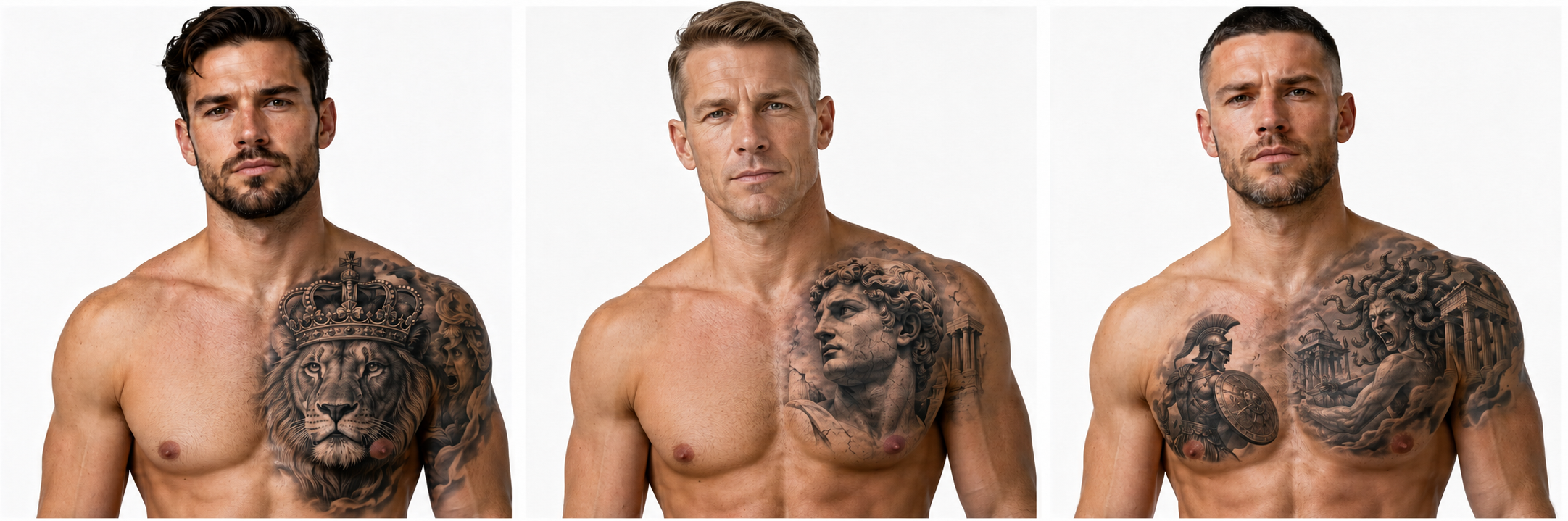
Realism works especially well for portraits, animals, classical statues, religious imagery and mythological scenes.
The chest gives the artist enough space to create depth, light and texture, but a realistic design should not be made too small.
Blackwork
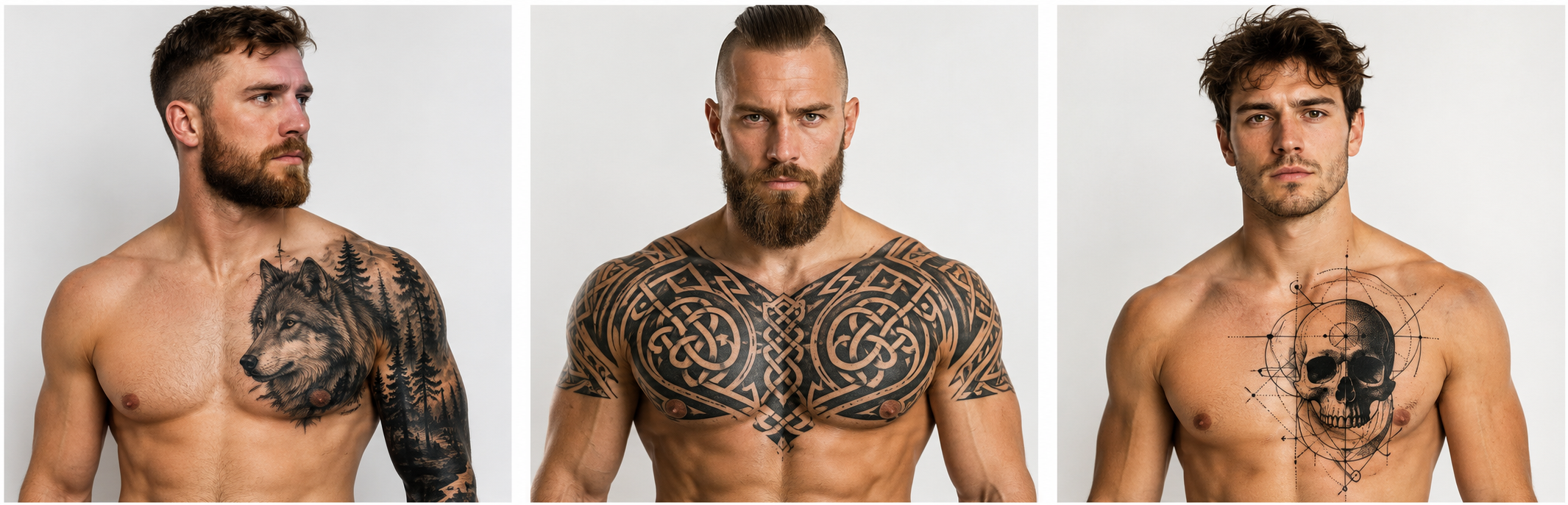
Bold black ink, large shapes and negative space make blackwork tattoos easy to read even from a distance.
This style can work equally well for a simple ornamental design or a large, dark composition.
Graphic Style

Clean lines, shading and strong contrast work well for animals, architecture, mythological figures and more complex custom designs.
Graphic tattoos can still feel light and balanced without losing their strong masculine character.
Traditional and Neo Traditional
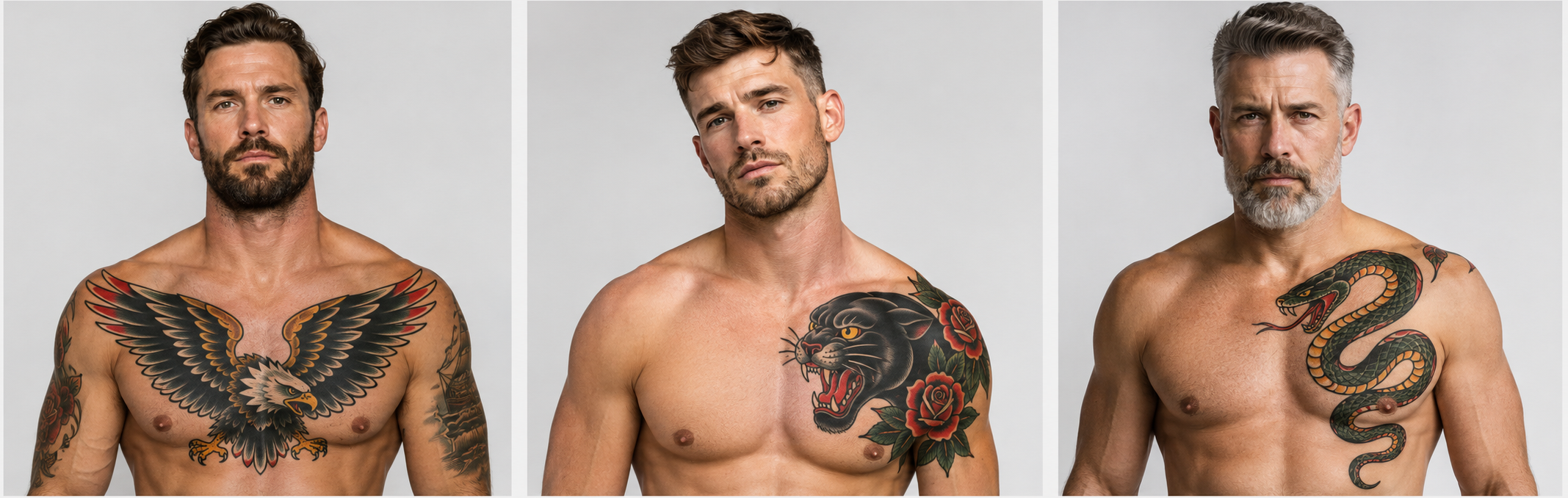
A bold outline helps the design stay clear and readable over time.
Popular chest tattoo ideas in these styles include eagles, panthers, snakes, roses, daggers, ships and hearts. Neo Traditional gives the artist more freedom with shape, color and detail.
Lettering
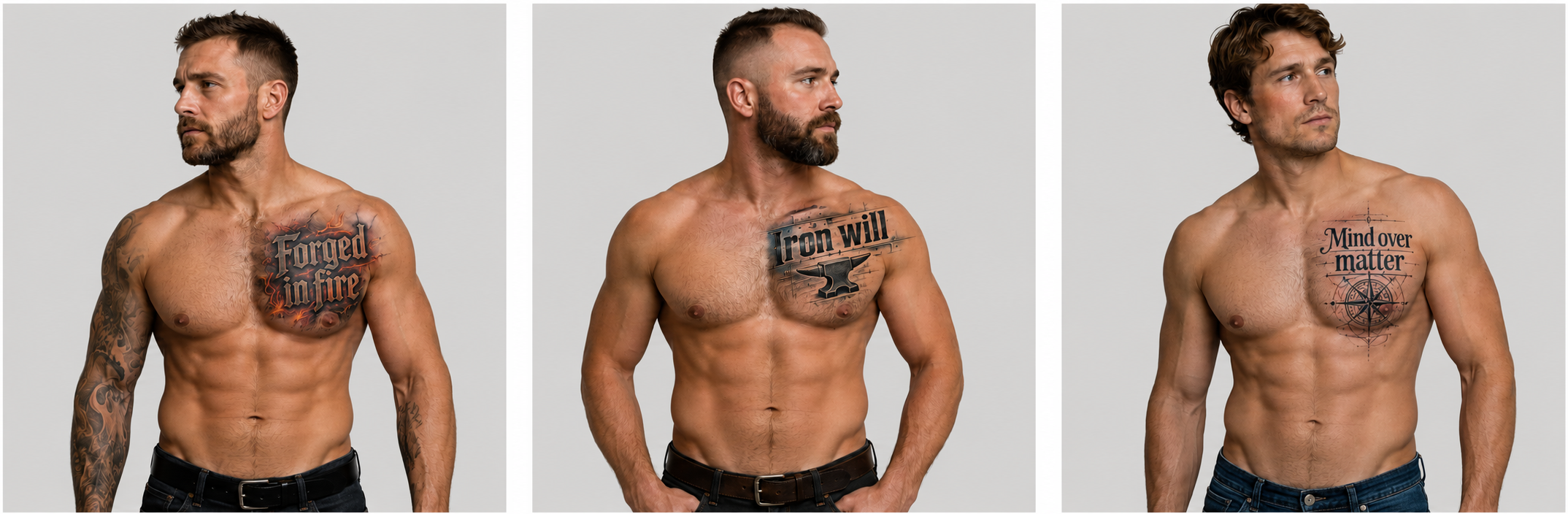
Lettering can sit under the collarbone, over the heart, or follow the curve of the pectoral muscle.
Before the stencil is transferred to the skin, check the spelling, translation, punctuation and dates more than once. A mistake in a tattoo does not become less noticeable with time.
Does a Chest Tattoo Hurt?

Yes, getting a tattoo on the chest can be painful, but the intensity depends on the exact area and your individual pain tolerance. There is no single pain rating that applies to everyone.
The sternum, collarbones, nipples and ribs are usually more sensitive because there is less soft tissue over the bone.
For many people, the outer part of the pectoral muscle feels more manageable.
During a long session, the area can also become more sensitive as the artist repeatedly works over already irritated skin.
| Area | What it may feel like |
|---|---|
| Outer pectoral area | Often feels like moderate burning or scratching. |
| Sternum | Can feel sharper because the bone is close to the surface. |
| Collarbone | Burning and vibration may feel more noticeable here. |
| Around the nipple | A sensitive area that can be more difficult to tattoo. |
| Toward the ribs | Often feels more intense because there is less soft tissue over the bone. |
A pain scale from 1 to 10 does not tell you much. For one person, the sternum may be the hardest part of the session, while someone else may tolerate it well but struggle more with a long period of shading or color packing.
How to Prepare for Your Tattoo Session
The day before your appointment, try to get enough sleep, eat properly and avoid alcohol.
Choose loose clothing that you do not mind getting stained with ink.
If chest hair needs to be removed, ask your tattoo artist when and how to do it so you do not leave cuts or irritation on the skin.
Do not apply numbing cream on your own unless your artist has approved it first. Some products can affect the skin, and using them incorrectly may cause an unwanted reaction.
For a large chest piece, it is often better to split the work into several sessions. A shorter session does not mean a lower-quality tattoo. It can give the artist more time to focus on the details and make the experience easier on your body.
Before your appointment, it is also worth reading the FDA’s tattoo safety recommendations, especially if your skin is prone to irritation or allergic reactions.
What to Check Before the Stencil Goes On
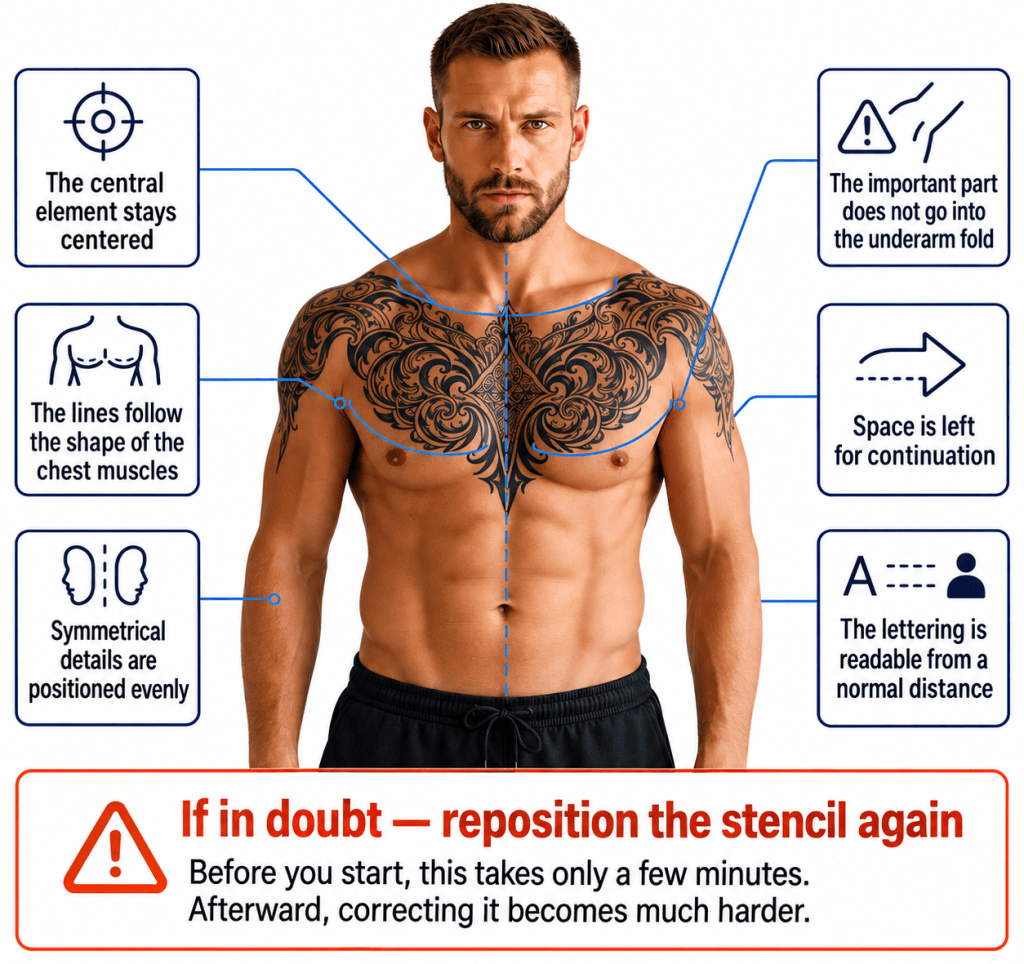
Look at the placement in a mirror while standing in a relaxed position.
Do not pull your shoulders back or tense your chest on purpose. Most of the time, the tattoo will be seen when your body is in its natural position.
Pay attention to:
- whether the central element looks properly aligned;
- whether the lines follow the shape of the chest muscles;
- whether symmetrical details sit evenly on both sides;
- whether an important part of the design disappears into the fold near the armpit;
- whether enough space has been left for a possible future extension;
- whether lettering is easy to read from a normal distance.
If the placement does not look right, ask the artist to reposition the stencil.
At this stage, making an adjustment only takes a few minutes. Once the tattooing starts, fixing the placement becomes much more difficult.
How to Care for a Chest Tattoo

Follow your tattoo artist’s instructions for the protective film, cleaning and any recommended aftercare product.
Avoid rubbing the fresh tattoo with rough fabric, soaking or steaming the skin, picking at peeling areas, or returning to intense workouts before the tattoo has had enough time to heal.
During the first few days, wear clean, soft, loose clothing.
Once the tattoo has healed, protect it from the sun. UV exposure can gradually fade the pigment over time.
Mild soreness, redness, itching, and peeling can be part of normal healing.
However, increasing pain, significant swelling, warmth, pus, a rash, or fever are signs that you should contact a doctor.
How to Make a Chest Tattoo Look Intentional
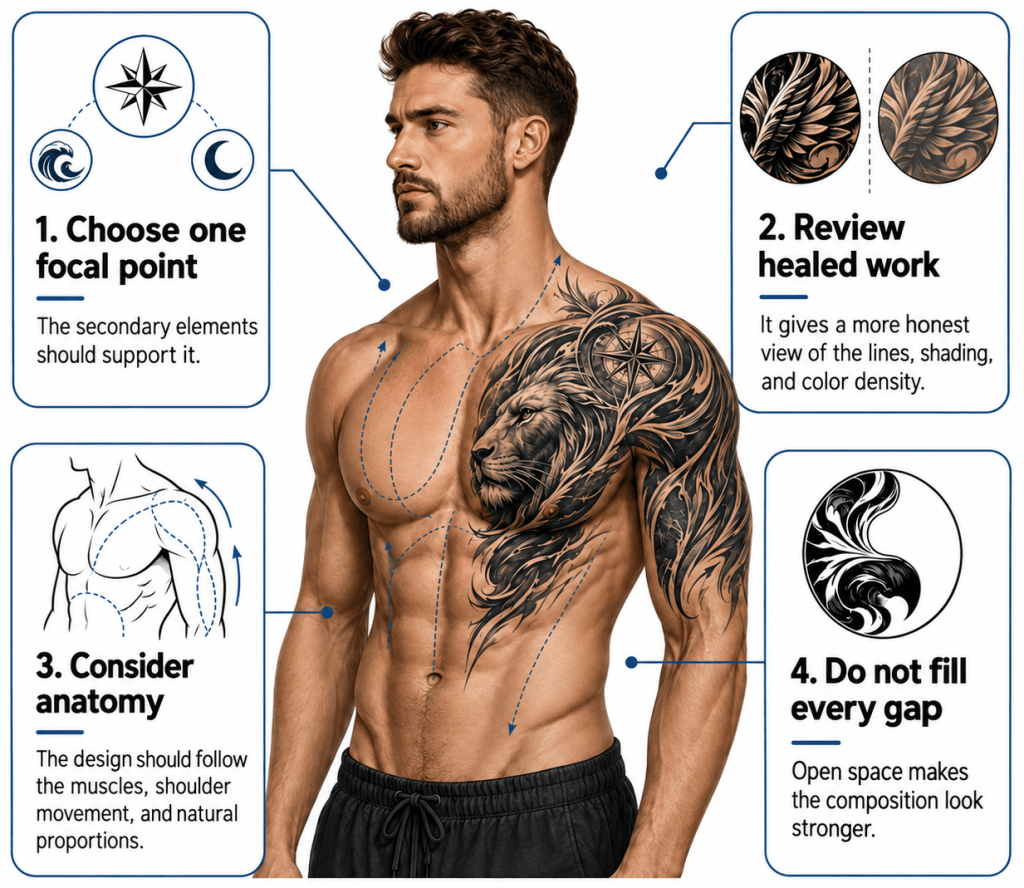
A strong tattoo does not have to look aggressive or cover the entire torso.
What matters more is having one clear focal point, with the surrounding details supporting the main idea instead of simply filling empty space.
Before booking your appointment, look through the artist’s healed work, not just fresh tattoos.
Fresh tattoos almost always look sharper and more saturated, while healed photos give you a better idea of how well the lines, shading and solid areas hold up over time.
A chest tattoo should be planned as part of the body, not as an image placed on top of the skin.
When the design works with the muscles, shoulder movement and natural proportions of the torso, it usually looks stronger without needing too many extra details or decorative elements.
Common Questions About Chest Tattoos for Men
Will the tattoo change if I build more chest muscle?
Moderate changes in body shape usually do not ruin the design. More noticeable distortion can happen after significant muscle gain, major weight loss, or stretching of the skin.
If you are planning a major body transformation, mention it to your tattoo artist before the design is finalized.
Can you tattoo over a scar?
Sometimes, yes, but it depends on the age, thickness, color, and condition of the scar.
The scar should be fully healed and stable. It is best to discuss it with an experienced tattoo artist and, if necessary, a dermatologist before moving forward.
Is it better to get a chest tattoo in winter or summer?
The season itself does not determine the quality of the tattoo, but cooler months can make it easier to avoid strong sun exposure, swimming, and heavy sweating.
In winter, however, make sure tight clothing does not rub against the fresh tattoo.
Can an old chest tattoo be covered with a new design?
Yes, but the new design usually needs to be larger and dark enough to cover the existing pigment.
A light, fine-line tattoo will not hide a dark old tattoo. In some cases, the artist may recommend partially lightening the old tattoo with laser treatments first.
How long does a chest tattoo take to heal?
The surface of the skin usually heals within about two to three weeks, but deeper healing can take around a month.
The chest generally moves less than areas such as the arms or legs, which can make the healing process a little easier for some people.
Can you tan with a new chest tattoo?
No. During the first few weeks, the tattoo should be kept out of direct sunlight.
Once it has fully healed, regular sun protection helps prevent the pigment from fading too quickly.
Can you go to the gym right after getting a chest tattoo?
It is better to avoid intense workouts for a few days.
Sweat, friction from clothing, and repeated movement can irritate fresh skin and make the healing process more difficult.
Read Also