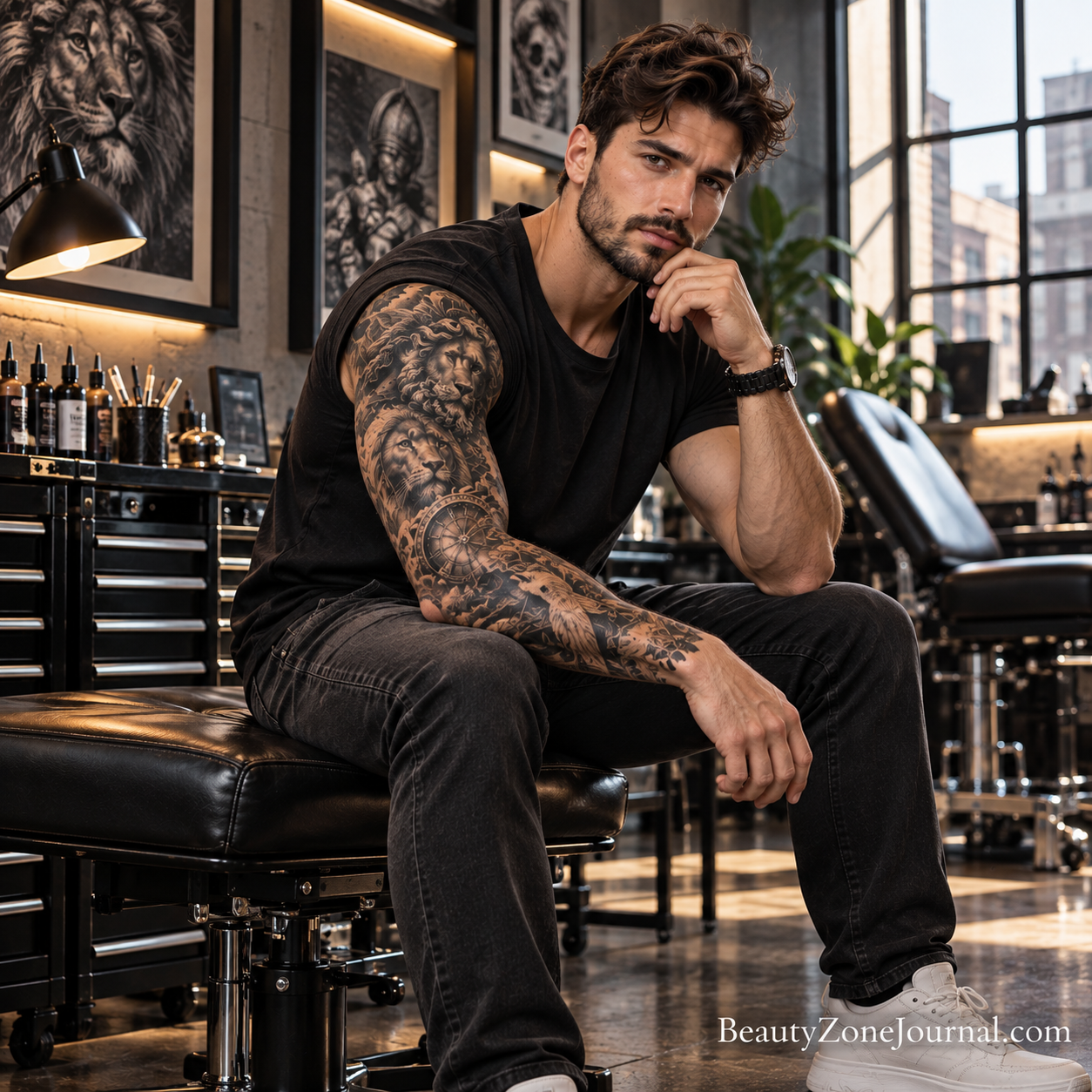
A tattoo sleeve rarely starts with the thought, “I want to cover my entire arm.”
More often, it begins with one design. Then another idea comes along, and eventually those separate tattoos need to work together rather than feel like unrelated pieces.
That is where planning becomes much more interesting.
Men’s tattoo sleeve styles can range from highly detailed realism to clean blackwork, Japanese designs, geometry, or graphic compositions. A sleeve can follow one large theme or bring several different images together.
A strong sleeve is not simply a collection of tattoos on the same arm. The transitions, focal points, proportions, and the way the design moves with the body all affect how complete the composition feels.
Table of Contents:
What is actually considered a tattoo sleeve?
A tattoo sleeve is one large design, or several connected tattoos, that cover a significant part of the arm and read as one composition.
It may run from the shoulder to the wrist, cover only the upper arm, or focus mainly on the forearm.
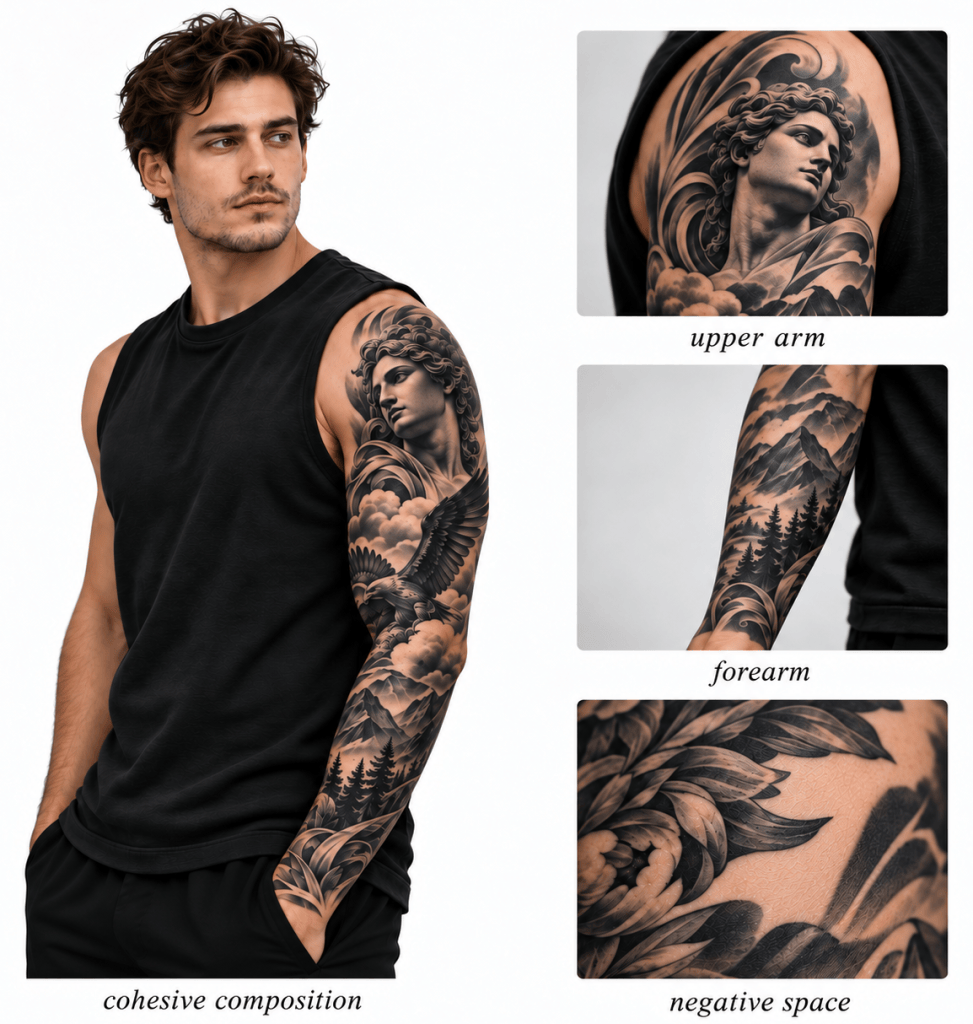
The skin does not have to be completely filled with ink. In some styles, negative space between the main elements is part of the design and keeps the sleeve from feeling too heavy.
Full sleeve or half sleeve?
The amount of arm you want to cover changes how the design needs to be planned.
| Sleeve type | Placement | Works well for |
|---|---|---|
| Full sleeve | shoulder to wrist | large scenes, several connected images, detailed backgrounds |
| Upper half sleeve | shoulder to around the elbow | large focal images, animals, portraits, ornamental work |
| Lower half sleeve | elbow to wrist | vertical compositions, graphic work, symbols, lettering |
| Partial sleeve | covers only part of the arm | lighter designs with more visible negative space |
A full sleeve gives you more room for a larger story, but it also needs more planning.
A half sleeve can be just as striking, especially when the main image suits the shape of the shoulder or forearm.
Men’s tattoo sleeve styles: where should the composition begin?
The background and small details should not come first.
Start with the main image. This is the part that will draw the eye first and set the tone for the rest of the sleeve.

It might be a wolf, lion, eagle, samurai, mythological figure, portrait, skull, dragon, religious image, or even a geometric composition.
Once the focal point is clear, the supporting details are much easier to choose.
A wolf might work naturally with a forest, mountains, or moon. A compass can be paired with a map, coordinates, or waves. A samurai can be surrounded by Japanese-inspired motifs, smoke, clouds, or other elements in the same visual language.
One story or several separate tattoos?
Both approaches can work.
In a fully planned sleeve, all the elements are designed as one large composition. A lion might flow into mountains, with a clock lower down and shading or natural scenery tying everything together.
This usually creates a very unified result.
The other option is to build a sleeve gradually from separate tattoos.
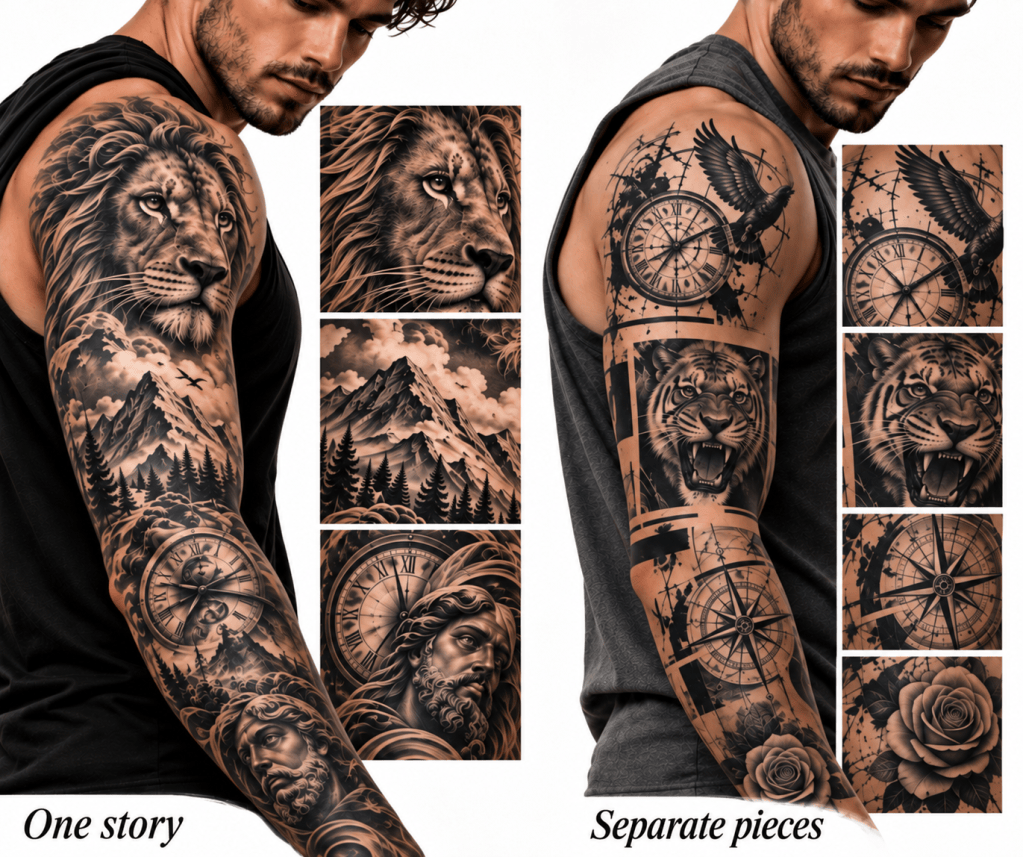
That can be more complicated. If every piece has its own border, different line weight, and a completely different style, joining them later may be difficult.
Even if the whole sleeve is not being done at once, having a rough idea of its future direction can make a big difference.
How to choose a style for a sleeve
Style affects more than the appearance of individual tattoos. It also determines how easily the separate elements can work together.
Realism
Realism suits animals, portraits, sculptures, warriors, clocks, and larger narrative scenes.
Transitions matter a lot in this type of sleeve. If several realistic portraits are simply stacked one below another, the arm can start to resemble a gallery of separate photographs.
A well-planned background helps connect them.
Blackwork
Blackwork can be dense and graphic, or it can use a careful balance of solid black areas and untouched skin.
It works well for ornamental patterns, bold graphic shapes, darker imagery, and abstract compositions.
The balance between black ink and negative space is especially noticeable in this style.
Japanese style
Japanese tattooing naturally suits larger designs that wrap around the arm.
Dragons, koi, snakes, tigers, waves, clouds, and other motifs can follow the shape of the body instead of sitting on the arm like a flat image.
Geometry
A geometric sleeve can be built around lines, repeated shapes, symmetry, and ornamental patterns.
It often feels cleaner and more restrained than a heavily detailed realistic sleeve.
Graphic style
Graphic tattoos work well with mythology, architecture, animals, abstract details, and strong lines.
This style also gives plenty of freedom when connecting different images across the arm.
Where to place the main elements
The arm is not a flat surface, so a large sketch cannot simply be stretched from shoulder to wrist.
The shoulder works well for a rounded focal image such as an animal head, mask, portrait, or central symbol.
The outer forearm suits longer compositions, while the inner forearm often works better for lighter details, lettering, or more personal symbols.
The elbow can be trickier because of the shape of the joint and the amount of movement in that area. A detailed image may not read the same way in every arm position.
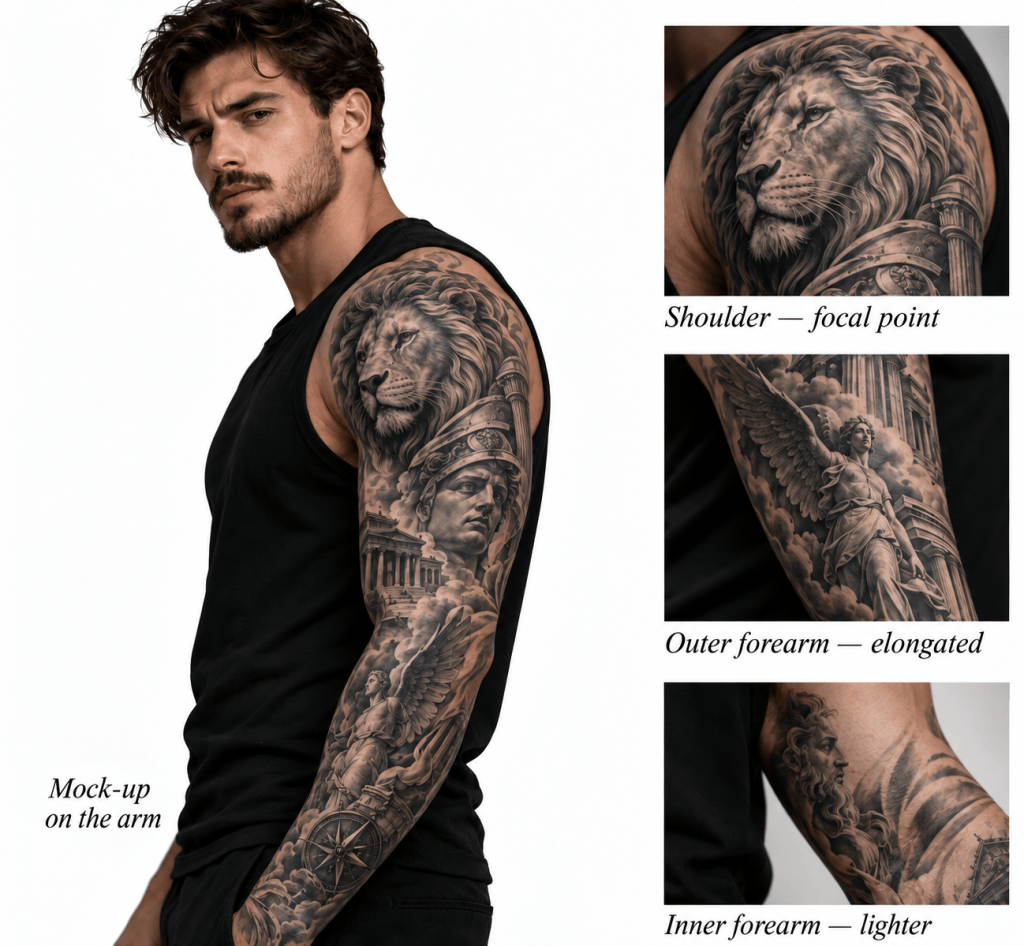
For that reason, the future sleeve is better judged not only as a flat drawing but also as a mock-up placed directly on the arm.
How to connect separate tattoos
A background should do more than simply fill empty spaces.
It works best when it continues the theme of the main images.
A forest can connect a wolf with mountains. Smoke can link a portrait and a clock. Waves can bring Japanese motifs together. Geometric lines can connect several graphic elements.
Shading can also create continuity, but covering every gap with dark shadow can make the sleeve feel too heavy.
Sometimes a few areas of clean skin make the whole composition stronger.
Do all the symbols need to have the same meaning?
No.
A sleeve does not have to tell one literal story from shoulder to wrist.
A lion may have one personal meaning, a date another, while a rose may simply be there because you like the way it looks.
The main thing is that the elements do not fight with each other visually.
Sometimes a strong visual connection matters more than trying to give every detail one shared meaning.
Lettering in a tattoo sleeve
Lettering can become a very personal part of the design, but it is better not to place it wherever there happens to be an empty gap.
A longer phrase needs enough room, while a short word or date can work as a smaller accent.
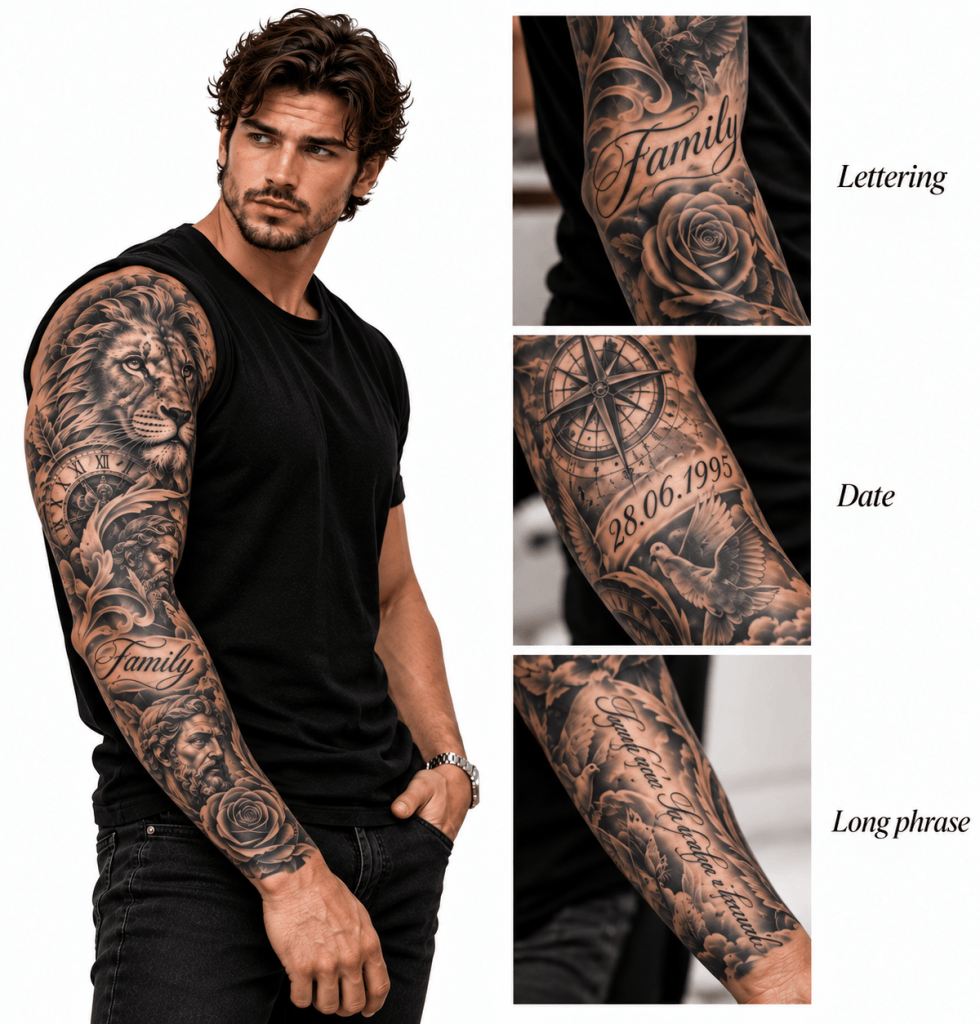
Direction matters too. The text should follow the natural shape of the arm and remain easy to read when the arm is in a relaxed position.
Why every element should not be the same size
If every part of the sleeve is equally large and equally bold, the eye has nowhere to settle.
A composition needs hierarchy.
One or two images can be the main focus, while smaller symbols, lettering, background work, and geometric details support them.
For example, a large lion portrait might take up the shoulder and upper arm, while a smaller compass sits below it. A map, trees, and coordinates can become supporting details rather than three more competing focal points.
That makes the sleeve much easier to read.
Color or black-and-grey?
Black-and-grey sleeves often rely on shading, contrast, and transitions between light and dark areas.
A color sleeve can feel more vivid, but the palette needs to be planned carefully.
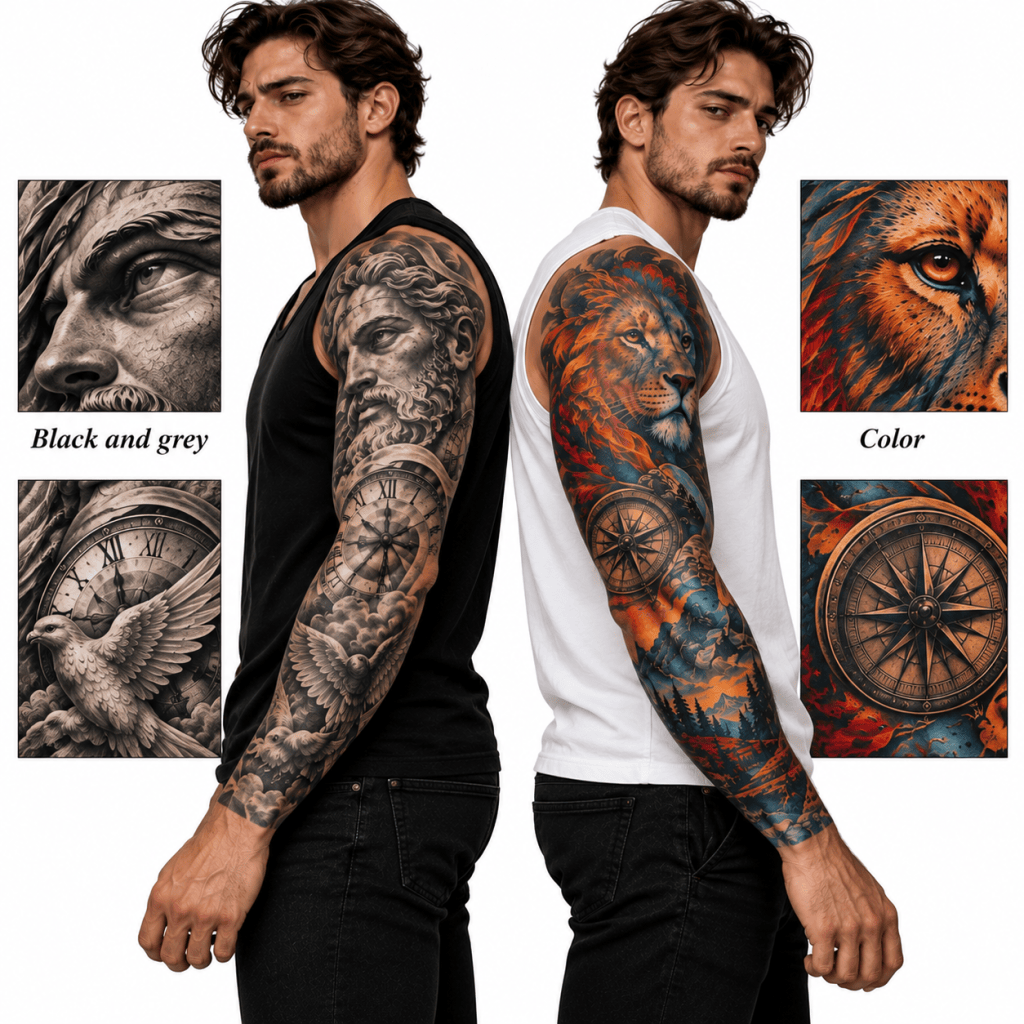
If one element is very warm, another very cool, and a third is done in a completely different visual style, it can be harder to bring everything together.
The colors do not need to match exactly. They simply need to work as part of the same composition.
Men’s Tattoo Sleeve Ideas for Inspiration
A men’s tattoo sleeve doesn’t have to follow one set formula. Even similar themes can look completely different depending on the main focal point, how the background is built around it, and how much open space is left in the overall design.
Below are a few examples featuring animals, portraits, symbols, ornamental details, and larger story-driven compositions. Rather than treating them as designs to copy, use them as inspiration – notice which elements draw the eye first, how several images are tied together, and how the transitions between them are handled.
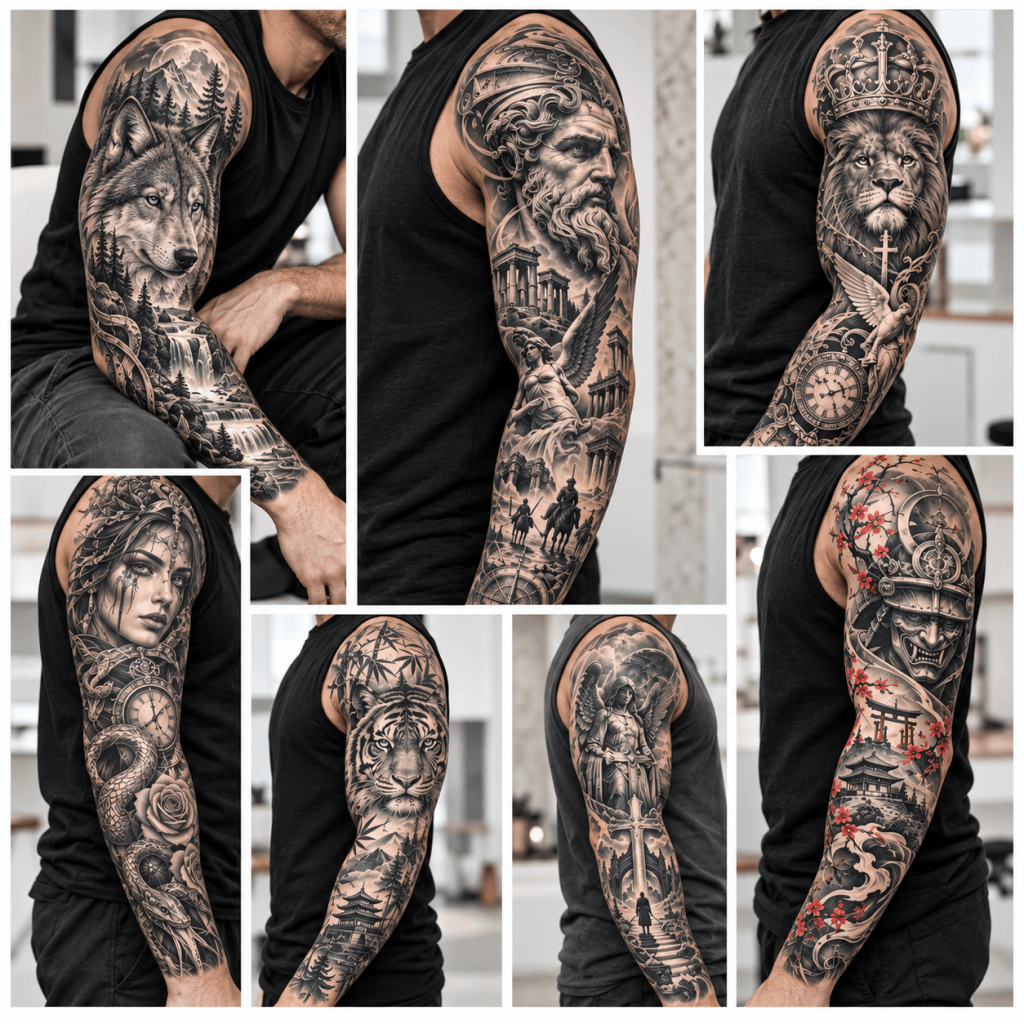
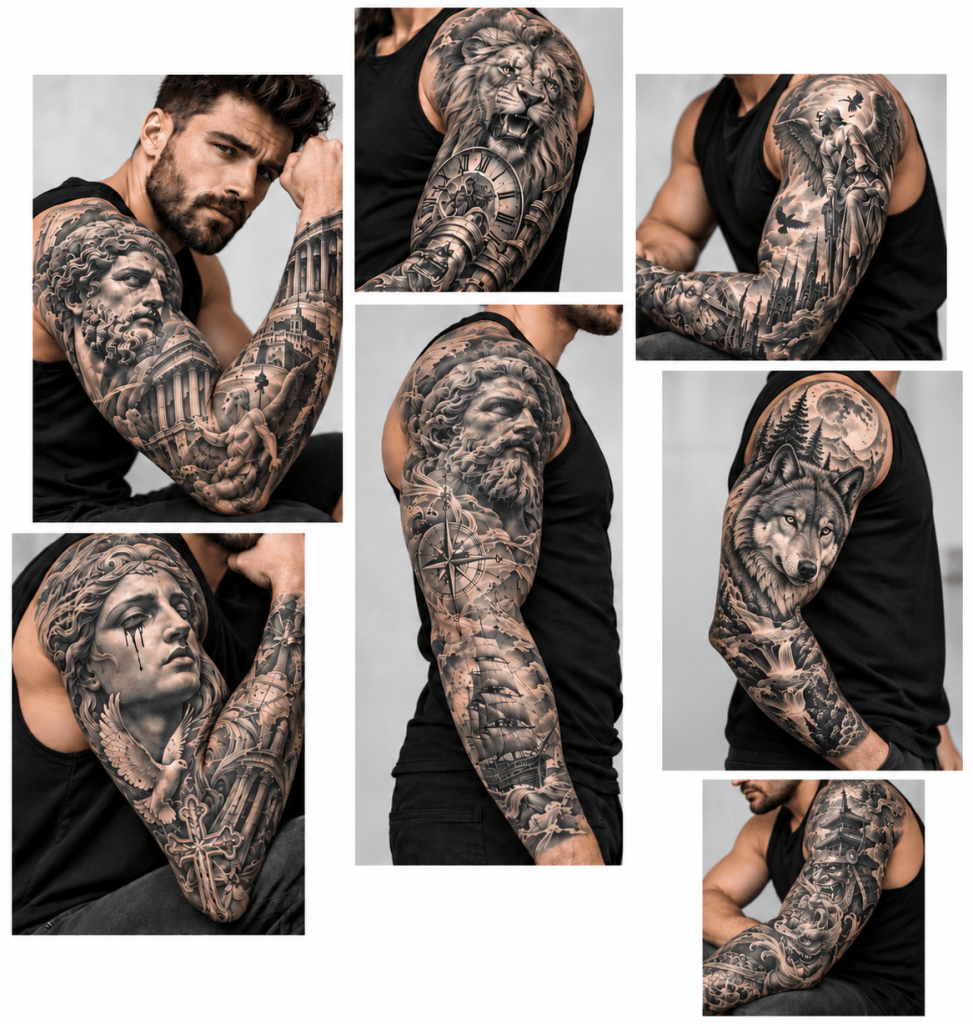

If a particular sleeve catches your eye, there’s no need to recreate it exactly.
Sometimes one detail is enough to spark an idea – a large image on the shoulder, a certain color palette, the way the background flows, or how the main elements are arranged. From there, you can build a design that feels more personal and doesn’t look like a copy of someone else’s work.
Can an existing collection of tattoos become a sleeve?
Yes, although a lot depends on what is already on the arm.
If the tattoos are similar in style and there is enough space between them, an artist may be able to build transitions and add new elements around them.
If the existing pieces are very different – for example, minimalist lettering, dense blackwork, and a colorful Old School tattoo – the process becomes more complicated.
In that situation, it may work better to make the differences part of the design instead of trying to hide them.
What to avoid when planning a sleeve
Try not to choose ten strong images and make every one of them the main feature.
A lion, eagle, clock, skull, rose, compass, samurai, and dragon may all work beautifully on their own. Without a clear plan, putting them together can easily turn into a collection of separate pictures.
The same applies to tiny details. They may look impressive on a screen, but the full composition still needs to make sense on a real arm from a normal viewing distance.
It is also better not to leave the elbow, inner arm, or transitions until the very end if the general sleeve concept is already planned. Those areas can make a big difference to how connected the final design feels.
How to choose an artist for a large sleeve
For a project this size, the portfolio matters a lot.
Do not only look at individual tattoos. Look specifically at larger arm pieces. They show whether the artist knows how to build a design around the shape of the arm, create smooth transitions, and leave enough breathing room between major elements.
Healed work is useful too. It shows how the tattoo looks after the skin has recovered rather than immediately after the session.
If you are still choosing a studio, it is also useful to check how the studio handles hygiene and tattoo safety before booking.
Common Questions
Do I need to get the entire sleeve done at once?
No. A sleeve can be built gradually. It is still better to have the overall composition in mind from the beginning.
Which is better: a full sleeve or a half sleeve?
It depends on the idea. One large focal image may work perfectly on half the arm, while a more complex composition with several major elements usually needs more space.
Can different tattoo styles be mixed in one sleeve?
Yes, but it is harder to make them feel connected. A shared background, color palette, composition, or graphic element can help tie them together.
Does the entire arm need to be covered with ink?
No. Negative space can be part of the design and can help larger elements stand out more clearly.
Can a forearm tattoo be extended into a sleeve later?
Yes, especially if the original design does not have a hard border and there is enough room around it for future additions.
Read also: