
Your hair looked incredible when you left the salon: sleek, glossy, not a flyaway in sight. Then came the first wash, and suddenly the frizz was back, your waves had reappeared, and your ends seemed to have their own agenda. So where exactly did that expensive salon finish go?
If you’re dealing with frizzy hair after keratin treatment, don’t blame your shampoo just yet. The problem could come down to the formula, the application technique, or the condition of your hair before the appointment. And no, booking another straightening session isn’t necessarily the answer.
Why Didn’t Your Keratin Treatment Work? 5 Possible Reasons
1. Your Hair Was Already Severely Damaged
Bleached, porous hair can look gorgeous immediately after a salon treatment. But once you wash it, that familiar roughness may return, especially around the ends.
Keratin smoothing can temporarily improve the hair’s surface, but it doesn’t restore damaged strands to their original structure.
What to look for: If your ends were tangling or breaking before the appointment, and they’re the first areas to lose their smooth finish, existing damage may be part of the problem.
2. The Formula Wasn’t Right for Your Hair
Not all treatments marketed as keratin deliver the same result. Some focus on reducing frizz, while others are designed to create a straighter finish.
If you expected pin-straight hair but ended up with softer, more manageable waves, the formula may simply not have been designed to deliver the look you had in mind.
Instead of asking, “Why didn’t the keratin take?” try asking your stylist: “What result was this particular formula supposed to give my hair?”
For a closer look at smoothing formulas and their potential risks, see our guide to Keratin Hair Treatment: Benefits, Risks, Results, and Aftercare.
3. The Results Are Uneven
Maybe your lengths are beautifully smooth, but the hair at the back of your head is still wavy. Or your face-framing pieces seem determined to ignore the entire treatment.
Uneven results can sometimes reflect differences in application. But they aren’t automatically proof of a stylist’s mistake.
Hair thickness, porosity, and natural texture can vary across your head, which may affect how different sections respond.
What to do: Compare the frizzy areas with how they looked before your appointment. If some sections seem noticeably different from the rest, show your stylist before agreeing to any correction.
4. Your Hair May Have Been Exposed to Too Much Heat
Many keratin smoothing services involve a flat iron. The catch? A temperature suitable for strong, untreated hair may be too aggressive for fragile, heavily bleached strands.
If your hair suddenly feels unusually stiff, tangles more easily, or starts snapping after the appointment, it’s worth having its condition assessed.
That said, frizz alone doesn’t prove heat damage. A rough-looking finish isn’t enough to tell you exactly what happened.
5. The Results Didn’t Last as Long as Expected
If your hair stayed smooth for several weeks before gradually becoming frizzy again, the smoothing effect may simply be fading.
How long it lasts depends on the formula, your natural hair texture, washing habits, and aftercare.
But if the smooth finish disappeared almost completely after your very first wash, it’s reasonable to ask the salon whether that result is typical for the product they used.
When Did the Frizz Come Back? Here’s What to Check
Before buying another hair mask, think about when the problem started.
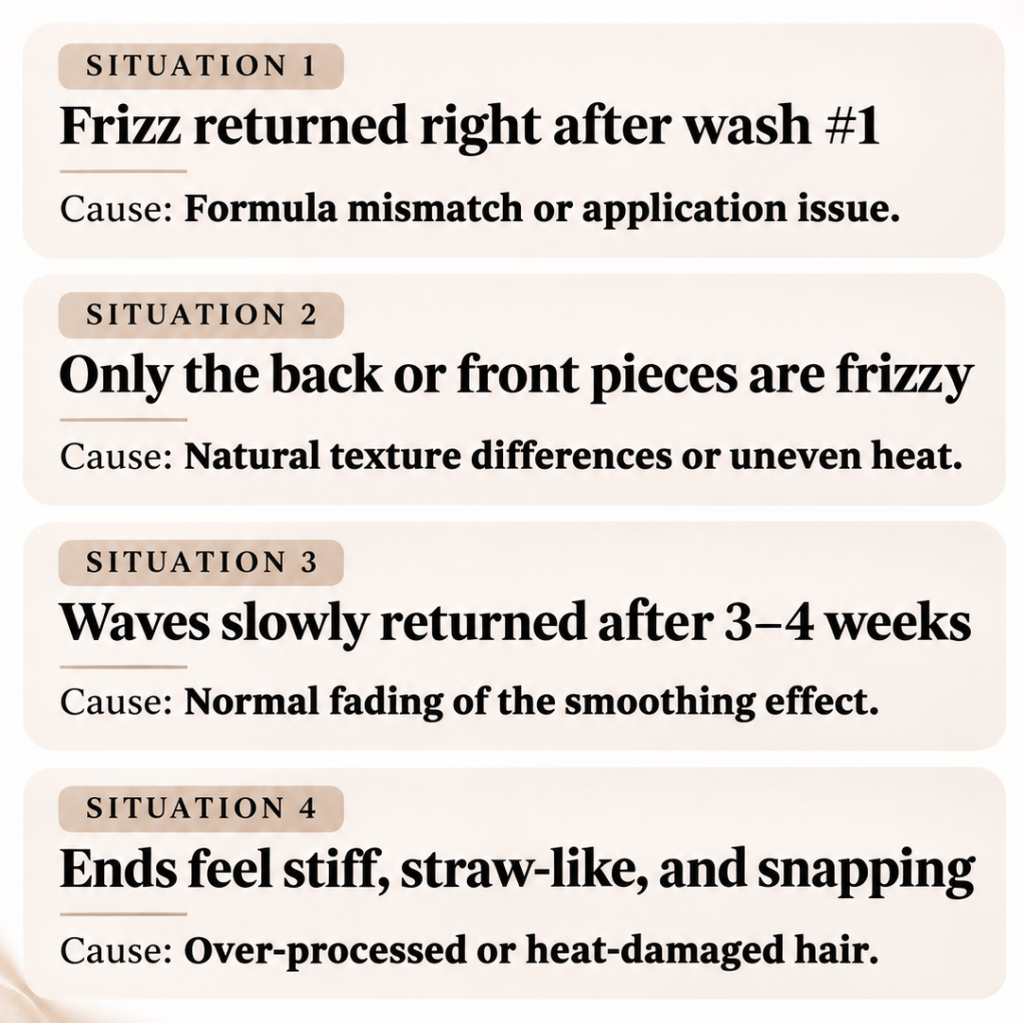
This isn’t a diagnostic test, but it can help you describe the problem clearly when you speak with your stylist.
Can You Fix Frizz Without Another Keratin Treatment?
Often, you can make your hair look and feel smoother without repeating the service. Just keep your expectations realistic: home care can’t always recreate the original salon result.
If your hair feels soft but looks frizzy, try a lightweight leave-in product containing Dimethicone or Amodimethicone. In a well-formulated product, these conditioning silicones can reduce friction and temporarily smooth flyaways.
If your lengths feel dry and tangle easily, look for conditioners with Cetearyl Alcohol or Behentrimonium Chloride. These ingredients can improve slip, making hair easier to detangle without unnecessary pulling.
If your hair feels stiff or coated, take a closer look at your routine. A protein mask, leave-in cream, oil, and multiple serums might sound like a luxury hair ritual. Sometimes, though, it’s just too much product.

Your hair doesn’t need a ten-step skincare routine in disguise.
Judge your products by how your hair responds, not by how convincingly the packaging promises repair.
If you want to build a gentle, everyday routine that protects your strands from stripping ingredients and heat damage, follow our full guide on Keratin Treatment Aftercare: How to Make Your Smooth Hair Last Longer.
Three Mistakes That Can Make Things Worse
- Booking another keratin treatment immediately. If your hair is already fragile, another round of chemical processing and high heat may increase breakage. Have its condition assessed before considering a redo.
- Flat-ironing the frizz away every morning. It may temporarily improve the appearance of your hair, but it won’t address the underlying issue. Frequent heat styling is particularly risky for compromised lengths.
- Buying every product labeled Repair. A mask can’t return permanently damaged hair to its original structure. Good conditioning can improve softness and manageability, but it can’t compensate for an unsuitable salon procedure.
When Should You Go Back to the Salon?
If your hair looks nothing like the promised result after the first wash, contact your stylist and explain what’s changed.
Take a few photos of your dry hair without straightening it first. That way, your stylist can see exactly which areas have lost their smooth finish.
Ask which formula was used, what results it was intended to deliver, and whether any correction would be appropriate for your current hair condition.
Don’t automatically agree to another high-heat service, especially if your ends have started breaking.
If you experienced scalp burns, significant irritation, or breathing difficulties during or after the treatment, seek medical attention rather than trying to solve the problem with hair products.
Frequently Asked Questions
Why is my hair even frizzier after a keratin treatment?
Previous damage, an unsuitable smoothing formula, or excessive heat may all play a role. Frizz alone can’t identify the cause. If you’re also experiencing breakage, have your hair assessed by an experienced professional.
Is it normal for keratin results to disappear after the first wash?
Not every smoothing treatment lasts equally long. Still, if the promised results disappeared almost entirely after one wash, ask your salon about the exact formula used and whether this outcome is expected.
Can a repair mask bring back the smooth finish?
A conditioning mask may soften your hair, reduce tangling, and temporarily smooth the surface. However, it can’t reliably restore the results of a salon straightening treatment.