

Cellulite can be visible regardless of your weight, age, or how often you exercise. It affects slim women as well as those who work out regularly, so dimpled skin should never be seen as a sign that someone does not take care of her body.
But why is the “orange peel” texture barely noticeable in some women and much more visible in others? And can massage, creams, diet, or exercise really change the way the skin looks?
Before spending time and money on empty promises, it helps to understand how cellulite forms, what makes it more noticeable, and what results you can realistically expect from at-home care and professional treatments.
Table of Contents
What Is Cellulite and How Does It Form?
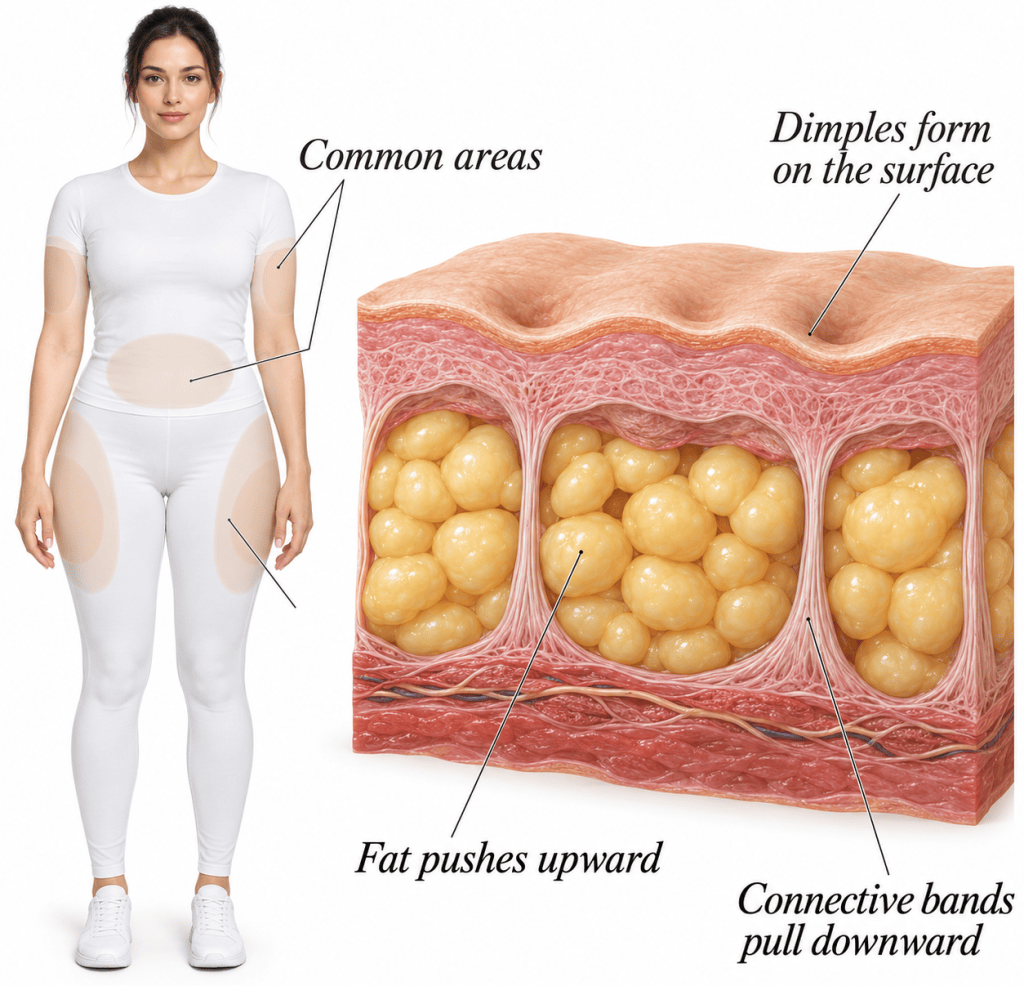
Cellulite is a change in skin texture that creates small dimples and bumps on the surface. It is most noticeable on the thighs, buttocks, abdomen, and upper arms. It is a common skin feature, not a medical condition.
Beneath the skin is a layer of fat crossed by strong connective tissue bands. These bands support the skin and attach it to the deeper tissues.
When fat pushes upward while the connective bands pull certain areas downward, the skin develops an uneven surface. This is what creates the familiar “orange peel” appearance.
How noticeable cellulite becomes does not depend only on the amount of body fat. Fat distribution, the structure of the connective tissue bands, skin thickness and elasticity, genetics, hormonal changes, and muscle tone all play a role.
This is why similar dimpling can appear in women who are overweight as well as those who are slim or physically active.
Why Is Cellulite More Noticeable in Women?
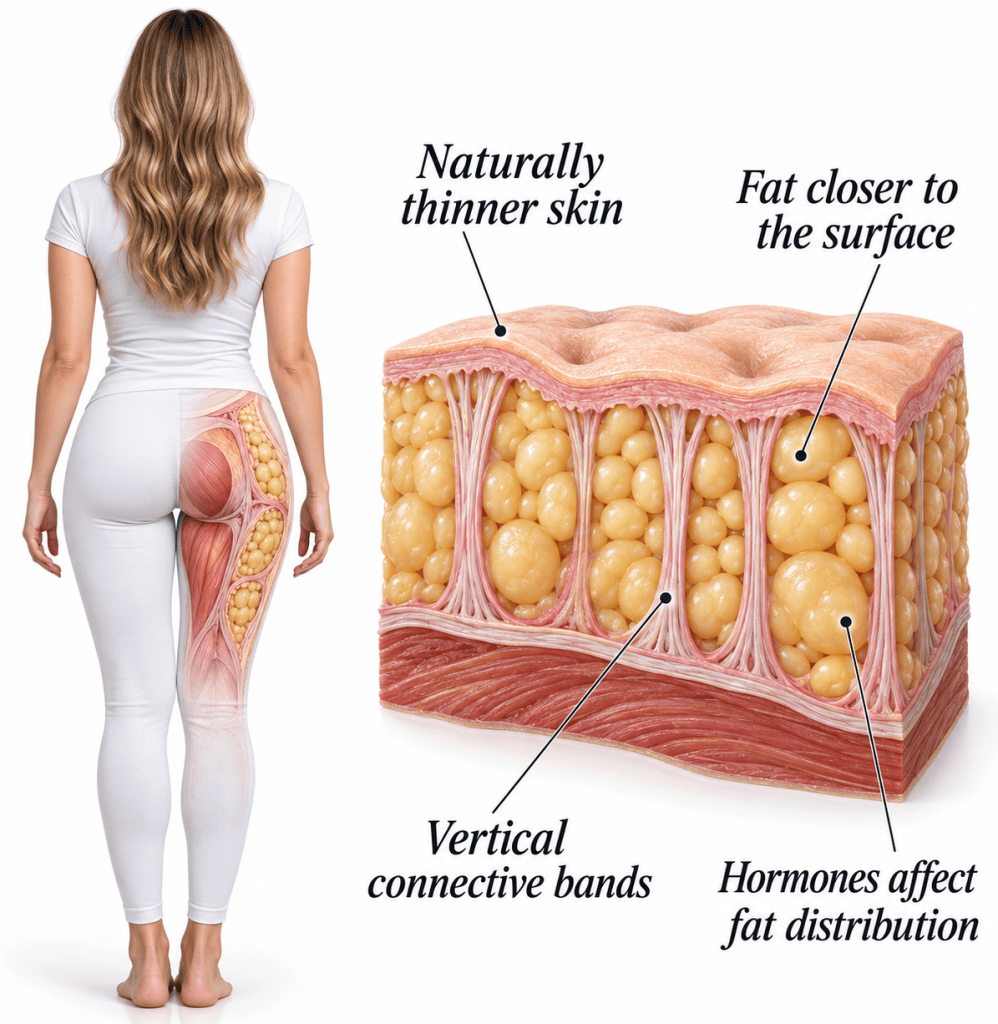
One of the main reasons is the structure of the tissue beneath the skin. In women, the connective tissue bands are often arranged in a way that allows dimpling to show more easily on the surface.
Fat distribution also plays a role. Women tend to store more fat around the thighs, buttocks, and abdomen – the areas where cellulite is usually most noticeable.
Hormonal changes can affect the skin as well. This is why dimpling may become more visible after puberty, during pregnancy, following changes in weight, or as the skin ages.
Men can develop cellulite too, but it is much less common. Differences in connective tissue structure, fat distribution, and hormones make their skin less likely to develop the characteristic dimples.
What Can Make Cellulite More Noticeable?

The appearance of cellulite can change throughout your life. Sometimes dimpling becomes more noticeable even without significant weight gain.
The most common factors that affect skin texture include:
- genetics and the natural structure of connective tissue;
- hormonal changes;
- loss of elasticity and gradual thinning of the skin with age;
- weight gain or sudden changes in weight;
- low muscle tone;
- long periods of inactivity;
- excessive sun exposure, which can speed up the loss of skin elasticity.
Weight gain can make dimpling more visible, but losing weight does not always make it disappear. If the skin becomes less firm after weight loss, cellulite may sometimes look even more noticeable.
This is why changes in skin texture should not be judged by the number on the scale alone. Several factors work together, including tissue structure, skin condition, and muscle tone.
Can Cellulite Be Prevented?

Cellulite cannot be completely prevented. Its development is strongly influenced by genetics, hormones, and the natural structure of the tissue beneath the skin.
Even a balanced diet, regular exercise, and consistent skin care cannot guarantee perfectly smooth skin. However, healthy habits can support skin firmness and make dimpling less noticeable.
The habits that may help most include:
- staying physically active;
- maintaining a stable weight without sudden changes;
- doing exercises that strengthen the muscles;
- eating a balanced diet;
- protecting the skin from excessive sun exposure;
- moisturizing regularly.
These habits cannot change the structure of the connective tissue bands, but they can help the skin look firmer and better cared for. A realistic goal is not to eliminate cellulite completely, but to make it less noticeable.
What Really Helps Make Cellulite Less Noticeable?

No at-home method can permanently change the structure of the connective tissue. However, certain habits can improve muscle tone, support skin firmness, and make its surface look smoother.
The results depend on your skin’s condition, age, genetics, and how consistent you are with your routine. Changes usually happen gradually rather than after just a few treatments.
Physical Activity and Muscle Tone
Strength training helps build the muscles beneath the skin. This can make the body look firmer and cellulite less noticeable.
Exercises that target the legs and buttocks can be especially helpful, including squats, lunges, glute bridges, and step-ups. You can combine them with walking, swimming, dancing, or cycling.
Exercise cannot burn fat in one specific area or remove cellulite completely. Its main benefits are stronger muscles and a more toned overall appearance.
Maintaining a Stable Weight
An increase in body fat can make skin dimpling more noticeable. In this case, gradual weight loss may help reduce the appearance of cellulite.
However, losing weight does not guarantee that the dimples will disappear. If weight is lost too quickly and the skin becomes less firm, its uneven texture may look even more pronounced.
For the appearance of your skin, maintaining a stable weight is more helpful than following one strict diet after another. Balanced eating and regular physical activity usually provide more predictable results than rapid weight loss followed by regaining the weight.
Diet and Water: Do They Affect Skin Texture?
No specific food can remove cellulite or change the structure of the tissue beneath the skin. Diet affects its appearance indirectly through body weight, skin condition, and overall well-being.
A balanced diet should include plenty of vegetables, fruit, whole grains, protein-rich foods, and healthy fats. This approach can help you maintain a stable weight without following restrictive diets.
Too much salt may temporarily increase fluid retention, which can make the skin look puffier. However, salt is not a direct cause of cellulite.
Drinking enough water supports normal hydration, but it does not “flush out toxins” or break down fat. Dry skin can make dimpling look more noticeable, so both proper hydration and regular moisturizing are important.
The goal is not to search for a special “anti-cellulite” diet, but to eat a varied, balanced diet and avoid sudden changes in weight.
Massage, Dry Brushing, and Skin Care Products

At-home care can make the skin look and feel smoother. However, the results are usually superficial or temporary.
Massage
Manual or roller massage may temporarily reduce puffiness and make the skin look smoother. The effect usually lasts only when treatments are repeated regularly.
Massage does not destroy fat cells or change the connective tissue bands. The pressure should be firm but not painful, and it should not leave noticeable bruises.
Dry Brushing
Dry brushing removes dead skin cells and makes the skin feel softer. Mild redness after brushing is caused by mechanical stimulation, not by “burning fat” or removing toxins.
Do not press too hard or brush the same area for too long. It is best to avoid dry brushing if the skin is irritated, broken, affected by a rash, or has prominent blood vessels.
Creams and Lotions
Moisturizers can help dry skin look smoother and firmer. However, a regular cream cannot penetrate deeply enough to change the underlying cause of cellulite.
Products containing caffeine may temporarily make dimpling less noticeable. Retinol creams may provide a modest improvement after several months of regular use, but they can irritate sensitive skin.
Before applying a new product, test it on a small area of skin. Claims that a cream can completely remove cellulite in just a few days should be treated as advertising rather than a realistic promise.
What to Know About Professional Treatments

Salon and medical treatments can make cellulite less noticeable, but none of them can guarantee permanently smooth skin. The results depend on the method used, the severity of the dimpling, and the structure of your tissues.
Mechanical massage treatments, radiofrequency therapy, and acoustic wave therapy may temporarily improve skin texture. A course of several sessions is usually needed, followed by maintenance treatments to preserve the results.
Laser treatments and subcision target the tight connective tissue bands that create dimples. Their results may last longer, but these are medical procedures that involve recovery time and possible side effects.
Liposuction removes localized fat deposits, but it is not designed to treat cellulite. In some cases, it can make the uneven texture look even more noticeable.
Before choosing a treatment, find out how it works, how many sessions you may need, and how long the results typically last. Medical procedures should be performed by a qualified professional who can assess your skin and explain the possible risks.
For a closer look at different procedures and their expected results, see the American Academy of Dermatology’s overview of cellulite treatments and what really works.
Common Myths About Cellulite
Myth: Cellulite only affects people who are overweight.
In reality, cellulite is common in slim and physically active women too. Weight can affect how noticeable it looks, but it is not the only cause.
Myth: Anti-cellulite creams can completely remove dimpling.
Creams mainly work on the surface of the skin. They may moisturize it and temporarily make it look smoother, but they cannot change the structure of the tissue beneath the skin.
Myth: The more painful the massage, the better the results.
Severe pain and bruising are not signs that a massage is working. Too much pressure can damage the skin and small blood vessels.
Myth: Drinking large amounts of water flushes out cellulite.
Your body needs water, but it does not break down fat or change the connective tissue bands. Drinking excessive amounts will not make the skin perfectly smooth either.
Myth: Cellulite means a woman does not take care of herself.
Cellulite is a common feature of female skin and is strongly influenced by genetics and tissue structure. Skin care can improve its appearance, but having cellulite does not mean that a woman is neglecting her body.
What Results Can You Realistically Expect?
It is possible to make cellulite less noticeable, but removing it completely and permanently is not always realistic. Even professional treatments provide temporary results and do not work equally well for everyone.
The most effective approach is usually a combination of regular physical activity, a stable weight, and simple skin care that keeps the skin moisturized. If you want a more noticeable improvement, you can consider professional treatments after consulting a qualified specialist.
A realistic goal is not perfectly smooth skin, but a firmer, more cared-for appearance without an exhausting struggle against your body. Cellulite is a natural feature, not a flaw that must be hidden.
Questions and Answers
Can cellulite appear during the teenage years?
Yes. It often becomes more noticeable after puberty due to hormonal changes and the development of the female pattern of fat distribution.
Why does cellulite look more noticeable in certain lighting?
Side lighting or bright overhead lighting creates shadows in small skin depressions. This can make the texture look more pronounced than it does in soft, even lighting.
Can cellulite become more noticeable during pregnancy?
Yes. Hormonal changes, weight gain, and skin stretching can all affect its appearance. After childbirth and once weight stabilizes, the skin texture may change again to some extent.
Can cellulite appear anywhere other than the thighs and buttocks?
Yes. It can also appear on the abdomen, hips, and upper arms, although it is less common in these areas.
When should skin changes be checked by a doctor?
Cellulite itself is not painful and does not require medical treatment. If changes appear suddenly and are accompanied by pain, significant swelling, redness, or a firm lump, it is best to see a doctor because something other than cellulite may be causing them.